


Age Criteria for Preschool Admissions 2027: A Complete Guide for Parents
September 5, 2026 2026-09-05 1:05Age Criteria for Preschool Admissions 2027: A Complete Guide for Parents
Age Criteria for Preschool Admissions 2027: A Complete Guide for Parents
 Admin
Admin If you’re a parent trying to figure out when your little one should start school, you’ve probably typed some version of “age criteria for preschool admissions” into Google more than once. It’s one of the first big decisions you’ll make for your child, and honestly, it can feel confusing — every school seems to quote a slightly different age, cut-off date, or rule.
Let’s simplify this together. In this guide, we’ll walk you through the age criteria for preschool admissions 2027, how these rules are decided, what the National Education Policy (NEP) 2020 says, and how you can figure out exactly which class your child qualifies for — Playgroup, Nursery, Junior KG, or Senior KG. We’ll also share what to look beyond age, because a number on a birth certificate is only part of the story.
Understanding the age criteria for preschool admissions early on gives you the time to plan your child’s admission calmly, instead of scrambling at the last minute.
Why Preschool Age Criteria Exist in the First Place
Preschools set age criteria for admission for a simple reason: children learn best when they’re grouped with peers who are at a similar stage of physical, social, and emotional development. A child who’s just turned 2 needs a very different kind of environment than a child who’s about to turn 4.
The age criteria for preschool admissions are also tied to a school’s academic calendar. Most schools in India follow a “cut-off date” system — usually 31st March — where a child’s age is calculated as of that date, not the date they walk into the classroom. So even if two children are born in the same calendar year, one might qualify for Nursery while the other has to wait for the next session, depending on where their birthday falls relative to the cut-off.
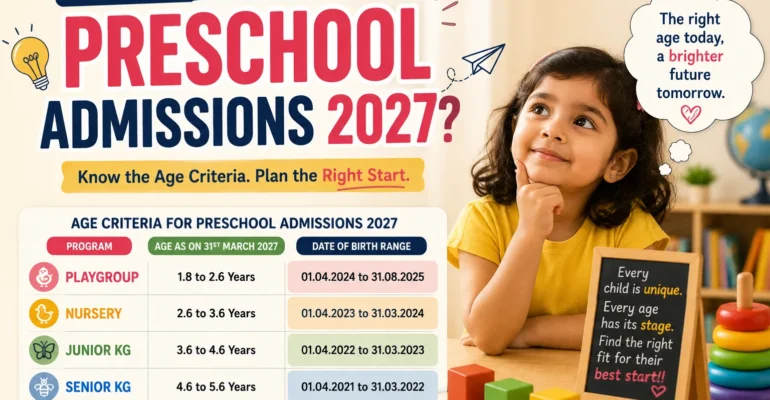
Age Criteria for Preschool Admissions 2027: Class-Wise Breakdown
Here’s a simple table that most Indian preschools — including CBSE, ICSE, and international curriculum schools — broadly follow. Always double-check with your shortlisted school, since a few weeks of relaxation is fairly common.
| Class/Program | Typical Age (as on 31st March of the admission year) |
|---|---|
| Playgroup | 1.5 to 2.5 years |
| Nursery / Pre-Nursery | 3 years (minimum) |
| Junior KG (Jr. KG) / LKG | 4 years (minimum) |
| Senior KG (Sr. KG) / UKG | 5 years (minimum) |
| Class 1 | 6 years (minimum) |
This structure lines up with the NEP 2020 framework, which recommends three years of preschool (commonly called Balvatika or the “Foundational Stage”) before a child moves into Class 1 at age 6. So if your child turns 3 by 31st March 2027, they’d typically be eligible for Nursery in the 2027–28 academic year, progress to Jr. KG the following year, and enter Senior KG the year after that — arriving at Class 1 right around age 6.
Keep in mind that this is the general age criteria for preschool admission followed by most schools — it’s always a good idea to check your shortlisted school’s exact prospectus for the final word.
How Age Criteria Vary by State and School
It’s worth remembering that the age criteria for preschool admission can differ slightly by state and by individual school policy. Delhi’s Directorate of Education, for instance, has periodically revised its minimum age and allowed a small relaxation window (often up to 30 days) for Nursery, KG, and Class 1. Maharashtra schools, including many in Mumbai, generally follow the same 31st March cut-off logic, though the exact minimum age can vary a little from one institution to the next — so it always pays to confirm directly with the school you’re applying to.
How to Calculate Your Child’s Eligibility
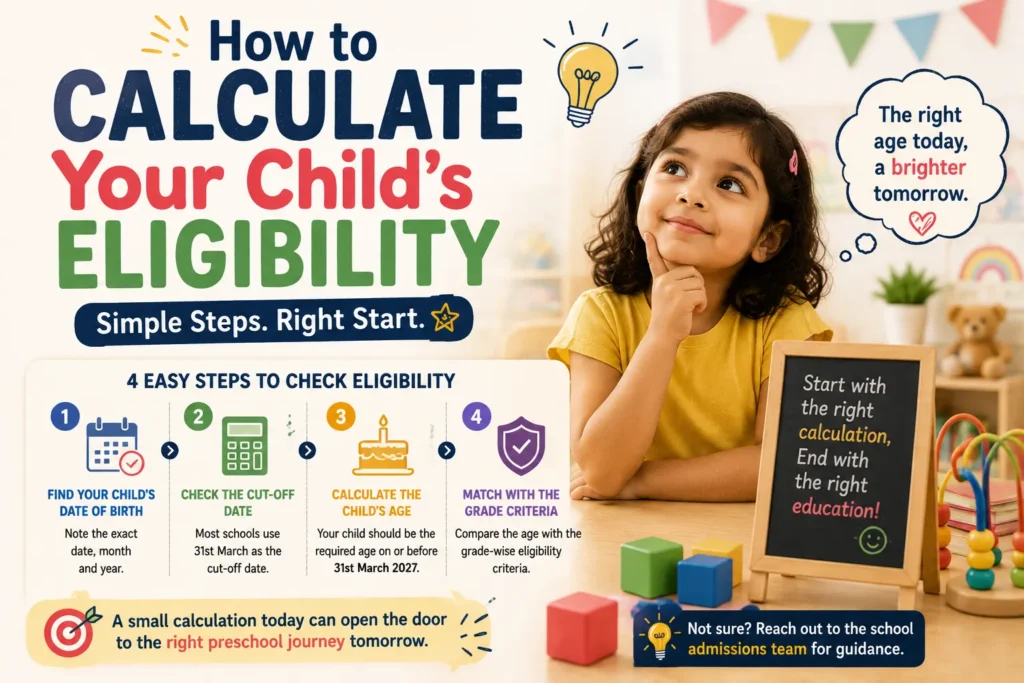
Parents often get stuck here, so let’s break it into simple steps:
- Find the school’s cut-off date. Most Indian schools use 31st March of the admission year, though a few use 1st June or a different date.
- Note your child’s date of birth.
- Calculate their age exactly as on the cut-off date — not today’s date, and not the date the academic year begins.
- Match that age against the school’s stated range for Playgroup, Nursery, Jr. KG, or Sr. KG.
- Check for any relaxation clause. Some schools allow a short grace period, usually at their discretion.
If your child’s birthday falls close to the cut-off, it’s genuinely worth having a conversation with a couple of shortlisted schools rather than assuming a strict “no.” This one step alone resolves most of the confusion parents have around the age criteria for preschool admissions.
Beyond the Age Criteria: Is Your Child Actually Ready?
Meeting the minimum age criteria for preschool admissions is only half the picture. Age tells a school what your child can legally be admitted for — it doesn’t necessarily tell you whether your child is emotionally and socially ready to spend a few hours away from you. Here’s what’s genuinely worth observing before the first day:
- Can they manage brief separations without prolonged distress? A little hesitation is completely normal; constant, inconsolable anxiety is a sign to wait a bit.
- Do they show curiosity about other children? Even watching other kids play, rather than actively joining in, is a good early sign.
- Can they communicate basic needs? They don’t need full sentences, but being able to point, gesture, or say a few words for “hungry,” “washroom,” or “hurt” makes a big difference.
- Are they developing some independence? Things like drinking from a cup, attempting to feed themselves, or showing interest in using the toilet are all encouraging signs.
This is exactly the kind of readiness that good early years programmes are built around. At Flamingo Kids Preschool, Panbai International School in Santacruz, admissions decisions aren’t just about a birth certificate — the programme is designed around what the school calls the “Six Early Skills,” covering emotional readiness, attention and routine, language and communication, social behaviour, independence, and confidence. It’s a helpful reminder for any parent: the right age criteria for preschool admission is simply the starting point, not the whole answer.
If you’re weighing your options in the Santacruz, Bandra, Khar, or Vile Parle belt, it’s worth exploring the Best pre school in Santacruz, where the early years programme is built around exactly this kind of holistic readiness rather than age alone.
Documents You’ll Typically Need
Once you’ve confirmed your child meets the preschool admission age criteria, keep these documents ready — most schools ask for some combination of the following:
- Child’s birth certificate (this is the primary proof used to verify age criteria for preschool admissions)
- Passport-size photographs of the child and parents
- Address proof
- Parent ID proof (Aadhaar, passport, etc.)
- Immunisation/medical records, if requested
- Passport copies, for schools following an international curriculum with visa-linked admissions
Common Mistakes Parents Make Around Preschool Age Criteria
Starting too early because a slot is available. A seat opening up isn’t a good enough reason to enrol a child who isn’t emotionally ready. It usually creates more stress for both child and parent than it solves.
Comparing children. Every child develops at their own pace. Just because a neighbour’s child started Nursery at 2.5 doesn’t mean yours needs to.
Assuming every school follows the same cut-off. Because age criteria for preschool admission can vary by state, board, and even by individual school, it’s risky to assume one school’s rule applies everywhere. Always verify directly.
Ignoring the relaxation clause. Some schools do offer minor flexibility around the cut-off date — but this is entirely at the school’s discretion, so it’s worth asking rather than assuming either way.
Treating the age criteria for preschool admission as the only deciding factor. Age gets your child through the door; it’s the curriculum, teachers, and environment that decide how well they thrive once they’re inside.
Frequently Asked Questions
What is the age limit for LKG in 2027?
Most schools expect a child to be around 4 years old (as on the cut-off date, usually 31st March 2027) to be eligible for Junior KG/LKG. A few months’ variation is possible depending on the individual school.
Is 3 years old the right age for preschool?
Yes, for most children, 3 years is a commonly accepted age to begin structured preschool (typically Nursery), and it aligns with NEP 2020’s foundational stage guidelines. That said, readiness — not just age — should guide the final decision.
What is the age limit for preschoolers overall?
Broadly, “preschool age” spans roughly 1.5 to 5 years, covering Playgroup, Nursery, Junior KG, and Senior KG, before a child moves into Class 1 at 6.
Is it compulsory for my 3-year-old to go to school in India?
No. Under India’s Right to Education (RTE) Act, free and compulsory education is guaranteed from age 6 (Class 1) to 14. Preschool for children under 6, including Nursery and KG, is not legally mandatory, though it’s widely recommended for early development.
Is it mandatory for kids to go to school in India?
Formal schooling becomes mandatory from Class 1 onward (age 6), as per the RTE Act. Preschool years are optional but strongly encouraged, since a large share of brain development happens before age 6.
What is the ideal age for starting school?
For preschool specifically, most experts and NEP 2020 point to around 3 years for Nursery. For formal schooling (Class 1), 6 years is the standard across most Indian states.
Is it normal for a 3-year-old to not want to go to school?
Yes, this is very common in the first few weeks. Separation anxiety usually settles down as the child builds trust with teachers and a routine. If distress continues well beyond the settling-in period, it’s worth discussing with the school and, if needed, a paediatrician.
Choosing a Preschool That Gets the Age Criteria — and the Child — Right
Meeting the age criteria for preschool admissions is just the entry point. What actually shapes your child’s first experience of school is the environment they walk into — the teachers, the curriculum, the emotional support, and how genuinely the school understands early childhood development.
This is where Panbai stands apart. As one of the best international school in Mumbai, Panbai brings the same rigour and internationally aligned approach right down to the preschool level through Flamingo Kids, so the transition from Nursery to Grade 1 feels seamless rather than jarring. If you’re comparing your options across the city, this overview of the Best Preschool in Mumbai is a useful place to start.
A Final Word for Parents
The age criteria for preschool admissions 2027 will largely follow the same logic that’s been in place for the past few years — a March cut-off, a minimum age of around 3 for Nursery, and a steady progression through KG before Class 1. But don’t let a date on a form be the only factor in your decision. Look for a school that treats your child as more than an admission number — one that notices whether they’re ready, nurtures them if they’re not quite there yet, and builds the confidence they’ll carry well beyond their preschool years.
