


A Level Science, Commerce, or Humanities: Which Stream Should Your Child Choose in Mumbai
July 30, 2026 2026-07-30 16:47A Level Science, Commerce, or Humanities: Which Stream Should Your Child Choose in Mumbai
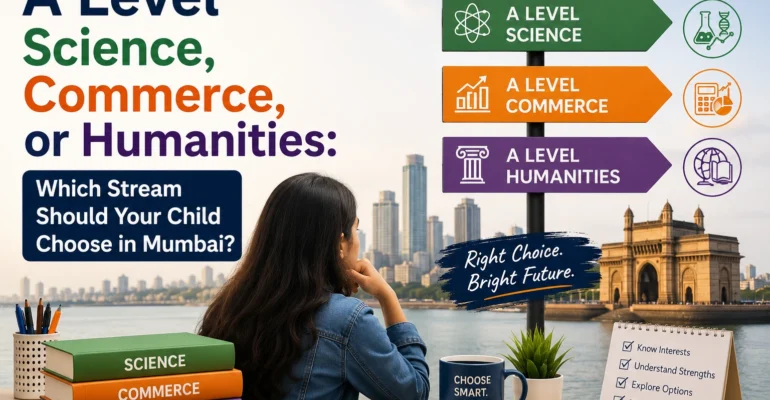
A Level Science, Commerce, or Humanities: Which Stream Should Your Child Choose in Mumbai
 Admin
Admin The school decision is made. The A Level programme is confirmed. And then comes the question i that keeps parents up at night in Grade 9 and 10: which stream — science, commerce, or humanities — should my child choose?
The anxiety is understandable. Unlike CBSE, where the stream choice is relatively contained within fixed subject groups, Cambridge A Levels offer genuine cross-stream flexibility. A student can combine Physics with Economics. A student can take Biology alongside Psychology and Sociology. A student can mix Computer Science with Business Studies. This flexibility is one of the most valuable features of the Cambridge A Level system — and also, for many parents, the most confusing part of the decision.
This guide approaches the question from the one angle that actually matters: university outcomes and career pathways. Not “what is the easiest stream” or “which stream is most prestigious” — but “if my child wants to do X after Grade 12, which subjects should they be taking now in Grade 11?”
Every combination recommended in this guide maps directly to a real university pathway — in India and internationally.
Why Stream Choice at A Level Is Different From CBSE
Before the guide itself, it is worth being explicit about what makes this decision structurally different from the CBSE Class 11 stream choice.
In CBSE, streams are largely fixed: Science (PCM or PCB), Commerce (with or without Mathematics), and Arts/Humanities. Subject combinations within these streams are mostly standardised across schools. The decision is made once, and students follow the stream.
As foLlowed by the best a level schools in Mumbai, In Cambridge A Levels, the stream labels — Science, Commerce, Humanities — are useful shorthand but are not rigid constraints. At a school like Panbai International School in Mumbai, students choose one subject from each of six groups, and those groups span the full range of Science, Commerce, and Humanities options. The result is that a student’s “stream” is really just a description of the combination they build — and cross-stream combinations are not only permitted but often strategically superior for specific university and career goals.
This is both the opportunity and the source of anxiety. The guide below simplifies it: start with where your child wants to go, then work backwards to which subjects get them there.
How to Use This Guide
Each section below covers one destination — engineering, medicine, business, computer science, social sciences, and creative fields. For each destination, the guide specifies:
- The core A Level combination that most directly supports that pathway
- The university implications — which specific Indian and international programmes accept or prefer it
- The honest caveats — what this combination does not open, and what supplementary steps are needed
If your child is genuinely undecided between two directions, the cross-stream combination section at the end shows how Cambridge A Levels can keep multiple doors open simultaneously — something CBSE cannot do as well.
A Level Science Stream in Mumbai: What It Opens and What It Requires
For Engineering: Physics + Chemistry + Mathematics
This is the canonical science combination for students targeting engineering — in India and internationally. It is the combination that satisfies JEE Main and JEE Advanced eligibility (Physics, Chemistry, Mathematics are the required subjects), UK and US engineering programme entry requirements, and most engineering and physical sciences undergraduate programmes globally.
Subjects in this combination:
- English General Paper or English Language (compulsory, Group 1)
- Mathematics & Statistics (Group 2)
- Physics (Group 3)
- Chemistry (Group 4)
- Computer Science or IT (Group 5) — as the fourth subject for Indian university requirements
- Optional: Biology or Business Studies (Group 6) as a fifth if the student is certain about load management
What this opens: Mechanical, electrical, civil, aerospace, chemical, and electronics engineering at IITs (via JEE), NITs, and private engineering universities in India including VIT and Thakur College. In the UK, engineering programmes at universities including Imperial College London, University of Nottingham, University of Sheffield, and Southampton accept Cambridge A Levels in this combination. In the US, Physics, Chemistry, and Mathematics at A Level is a well-regarded application profile for engineering at Purdue University, University of Arizona, and similar institutions — both of which Panbai alumni currently attend.
The honest caveat: JEE Main and JEE Advanced question patterns are built entirely around the NCERT syllabus. A Level Physics and Mathematics cover equivalent content — often in greater depth — but not in the NCERT format. Students targeting JEE need structured NCERT-based coaching running alongside their A Level programme from Grade 10 onwards. This is an additional commitment. Schools with strong career counselling — like Panbai, where counselling begins from Grade 7 — ensure students with JEE ambitions identify this requirement early enough to plan for it.
For Medicine and Biomedical Sciences: Physics + Chemistry + Biology
The medical science combination is the most constrained of all A Level pathways — not because it is difficult, but because NEET eligibility is non-negotiable and leaves less room for subject flexibility.
Subjects in this combination:
- English General Paper or English Language (compulsory, Group 1)
- Mathematics & Statistics (Group 2) — strongly recommended, required by many biomedical programmes
- Physics (Group 3)
- Chemistry (Group 4)
- Biology (Group 6)
- Optional fourth subject: Psychology (Group 3) — a strategically excellent addition for medicine, increasingly valued by medical school admissions
What this opens: NEET eligibility for MBBS in India (Physics, Chemistry, and Biology are required). K. J. Somaiya Physiotherapy — where Panbai alumna Dr. Poorva Malkar completed her degree via A Level Science. International Medical University Malaysia — where Panbai alumna Syali Vartak is currently completing her Bachelor of Science. Biomedical science, pharmacy, nursing, veterinary science, and dentistry programmes at UK, Australian, and Canadian universities. For students with Psychology as a fourth subject, clinical psychology and health science programmes become additionally accessible.
The honest caveat: NEET is as closely calibrated to the NCERT syllabus as JEE. A Level Biology and Chemistry cover overlapping content but through a different lens. Students targeting NEET need NCERT-focused supplementary preparation — this is particularly important for Biology, where the NEET syllabus includes specific NCERT chapters that A Level Biology does not always cover in the same sequence. Early planning — from Grade 9 or 10 — makes this manageable. Late planning makes it significantly harder.
For Physical Sciences and Research: Physics + Chemistry + Mathematics
The same combination as engineering — but with a different university application focus. Students targeting pure science degrees (Physics, Chemistry, Mathematics, Materials Science) at UK or US universities often benefit from dropping the engineering application framing and instead emphasising research interest and subject depth in their personal statements. This combination is also the right profile for actuarial science when combined with Mathematics at the highest grade.
A Level Commerce Stream in Mumbai: What It Opens and What It Requires
For Business, Management, and Finance: Mathematics + Accounting + Economics
This is the strongest commerce combination for students targeting BBA, B.Com, economics, and business management programmes — at Indian universities and internationally.
Subjects in this combination:
- English General Paper or English Language (compulsory, Group 1)
- Mathematics & Statistics (Group 2)
- Accounting (Group 3)
- Economics (Group 4)
- Business Studies (Group 6)
- Optional fifth: IT or Computer Science (Group 5) — increasingly valued for finance and business technology roles
What this opens: BBA and B.Com at NMIMS Mumbai — where multiple Panbai alumni are currently enrolled including Dev Vagrecha (BBA) and Diya Dedhiya. Business and management programmes at Symbiosis, K. J. Somaiya, SP Jain, and Narsee Monjee. For international universities, this combination is well-suited for undergraduate business programmes at Nottingham Trent University UK (where Panbai alumnus Shishir Balagiria is completing B.A. (Hons) in Business Administration), California State University USA (where Panbai alumna Foram Bhansali is completing her BBA), and Boston University USA.
For the NMIMS NPAT entrance test — one of the primary routes to BBA in Mumbai — A Level students with Mathematics, Accounting, and Economics are well prepared for the quantitative and analytical sections. For Ashoka University, this combination combined with strong English and the IPQ research project creates a highly competitive liberal arts business application.
The honest caveat: Students who have not taken Mathematics at A Level find certain business and economics degree programmes — particularly at competitive UK universities (LSE, UCL, Warwick Economics) — harder to access or receive conditional offers for. If there is any possibility of economics at a research-intensive university, Mathematics is the subject to keep in the combination.
For Chartered Accountancy (CA) Alongside a Degree
Cambridge A Level Accounting gives students a genuine head start on the CA Foundation examination — the first level of the Institute of Chartered Accountants of India qualification. The conceptual framework of financial accounting, cost accounting, and management accounting at A Level overlaps significantly with CA Foundation content. Students who take Accounting at A Level and plan to pursue the CA qualification alongside their undergraduate degree in commerce are starting from a stronger foundation than most CBSE Class 12 students, who study Accountancy at a more elementary level.
For Economics, Public Policy, and Social Sciences: Economics + Mathematics + Sociology or Psychology
This is a genuinely underused combination at A Level in Mumbai — and one of the most strategically powerful for students interested in economics, public policy, development economics, or social science research.
Subjects in this combination:
- English General Paper or English Language (compulsory, Group 1)
- Mathematics & Statistics (Group 2)
- Psychology or Accounting (Group 3)
- Economics (Group 4)
- Sociology (Group 5)
- Biology or Business Studies (Group 6)
What this opens: Economics and social science programmes at Ashoka University, FLAME University, OP Jindal Global University — all of which actively seek students with interdisciplinary A Level combinations. In the UK, the LSE, UCL, King’s College London, and the University of Edinburgh accept this combination for economics and social science programmes. For US liberal arts colleges, the combination of Economics + Sociology or Psychology at A Level signals exactly the interdisciplinary thinking these institutions value.
A Level Humanities Stream in Mumbai: What It Opens and What It Requires
The humanities stream at A Level is the most underappreciated and the most flexible — and the one where Cambridge’s cross-stream advantage is most pronounced.
For Law, Journalism, and Social Sciences: English + Psychology + Sociology
Subjects in this combination:
- English Language (Group 1) — specifically Language rather than General Paper for this pathway, for the depth of linguistic analysis it develops
- Mathematics & Statistics (Group 2) — important even for humanities students for quantitative research methods and data literacy
- Psychology (Group 3)
- Sociology (Group 5)
- Economics or Media Studies (Group 4) — depending on whether the student leans toward policy or media
- Business Studies or Art & Design (Group 6)
What this opens: Law programmes at Symbiosis Law School, Jindal Global Law School, and NMIMS School of Law. Journalism and mass media at Sophia’s College Mumbai (where Panbai alumna Dimple — A Level Business country topper — is currently studying Bachelor of Mass Media), Xavier Institute of Communications, and MICA. Social science, anthropology, and development studies at Ashoka, FLAME, and Tata Institute of Social Sciences. In the UK, humanities and social science programmes at the University of Edinburgh, University of Leeds, and King’s College London accept this combination readily.
For Media, Communications, and Creative Industries: Media Studies + Sociology + English
Subjects in this combination:
- English Language (Group 1)
- Mathematics & Statistics (Group 2)
- Psychology (Group 3) — or Accounting if the student has a business interest in media
- Media Studies (Group 4)
- Sociology (Group 5)
- Art & Design or Business Studies (Group 6)
What this opens: Mass Media (BA/BMM) programmes across Mumbai colleges — this combination is highly relevant for Sophia’s College, KC College, and Jai Hind College for Mass Media. Advertising and PR degree programmes at MICA and Symbiosis. Film studies, digital content creation, and communications degrees at UK universities. For students with Art & Design in the combination, creative arts and design degree programmes in India and abroad become additionally accessible. Panbai alumnus Harshit Gala — currently in his final year at ModArt Paris studying fashion design — took a creative pathway from A Levels that demonstrates exactly how far this route can go internationally.
For Art, Fashion, and Design: Art & Design + English + Psychology or Media Studies
For students with genuine creative talent and a portfolio to show, A Level Art & Design at Cambridge is assessed substantially on portfolio work — which means a student’s actual artistic ability is what drives their grade, not just their ability to write about art in an examination. This is a fundamentally different proposition from CBSE Fine Arts.
What this opens: Fine arts, graphic design, and fashion design programmes in India and internationally — including NIFT (National Institute of Fashion Technology), NID (National Institute of Design), Rachana Sansad, and international institutions like ModArt Paris and design schools in Italy, UK, and Australia. For NIFT and NID, A Level Art & Design combined with a strong portfolio is a genuinely competitive application profile.
Cross-Stream Combinations: Keeping Multiple Doors Open
This is where Cambridge A Levels genuinely distinguish themselves from CBSE — and where Panbai’s subject group structure creates real options that fixed-stream schools cannot match.
For Students Undecided Between Engineering and Business
Combination: Mathematics + Physics + Economics + Accounting
This is an unusual but strategically strong combination. Mathematics and Physics satisfy engineering eligibility. Economics and Accounting satisfy business and commerce programme requirements. A student who begins A Level undecided between these pathways can take this combination, perform strongly across all four, and make the final university decision at the end of Grade 11 based on actual performance and confirmed interest — rather than a guess made in Grade 9.
For Students Interested in Technology and Business Combined
Combination: Mathematics + Computer Science + Economics + Business Studies
This is one of the most future-relevant combinations available at A Level. It supports applications to technology management, fintech, business analytics, product management, and entrepreneurship programmes — all areas where the divide between technical and commercial skills is shrinking rapidly. For students interested in starting businesses, working in venture capital, or entering technology companies from a non-pure-engineering angle, this combination is exceptionally well-positioned.
For Students Interested in Psychology and Science Combined
Combination: Biology + Psychology + Mathematics + Sociology or Economics
This is a relatively rare but increasingly valued combination for students interested in behavioural science, public health, clinical psychology, human resources, and health policy. It is not possible under CBSE’s fixed streams — a CBSE Science student cannot formally study Psychology and Sociology alongside Biology. Cambridge A Levels make this combination fully accessible. For undergraduate programmes in behavioural science at Ashoka, FLAME, and similar institutions, this cross-stream combination is actively valued.
What Happens If Your Child Chooses the Wrong Stream
This is a question parents rarely ask but should. At Cambridge A Level, a stream choice is made at the beginning of Grade 11. Unlike CBSE, where changing stream after Grade 11 is administratively difficult and rarely done, Cambridge A Level subject changes are more manageable — particularly if identified early in Grade 11 before the full year’s teaching has progressed.
At Panbai International School, the A Level programme begins with a structured conversation about each student’s capabilities and career goals. Subject planning is personalised and counselled — not a form to fill in at admission. Students who join from IGCSE have had career counselling from Grade 7, meaning the stream choice discussion has been ongoing for years before the formal decision is made.
For students joining from CBSE, ICSE, or SSC, the academic guidance session at admission is specifically designed to surface these questions before the programme begins — not after. This early counselling is one of the specific reasons Panbai’s A Level alumni end up at destinations as varied as Boston University (USA), Purdue University (USA), University of Arizona (USA), Nottingham Trent University (UK), NMIMS (India), K. J. Somaiya (India), BITS Pilani (India), IIT Dharwad (India), ModArt Paris (France), and International Medical University (Malaysia). The breadth of those destinations is not accidental — it reflects subject combinations planned with genuine forward visibility.
How to Make the Stream Decision: A Practical Framework for Mumbai Parents
Rather than starting with the subject and working forward, start with the destination and work backwards. Here is a four-question framework:
Question 1: Is there a specific career your child is already drawn to? If yes — engineering, medicine, business, law, media, design — go directly to the relevant section above. The combination that opens that pathway is the starting point.
Question 2: Is the career goal India-specific or internationally open? If India and JEE/NEET are the goal, the combination must satisfy NCERT-adjacent eligibility and supplementary preparation must be planned. If international universities are a possibility, the combination should be built to demonstrate subject depth and analytical range.
Question 3: What is your child genuinely strong at — not what they enjoy casually, but what they engage with consistently at a high level? A Level requires two years of sustained study at significant depth. A student who is strong at Mathematics but chose it reluctantly will find the workload unsustainable. A student who is genuinely curious about Economics but worried it is “not serious enough” will outperform their anxiety in the long run. Subject strength matters as much as strategic fit.
Question 4: Is your child’s interest genuinely cross-stream — or have you assumed it is because they have not been told a cross-stream combination is possible? Many Mumbai students default to CBSE-style stream thinking when evaluating A Levels — assuming they must choose “Science” or “Commerce” as a block. One of the first conversations a good A Level counsellor has is simply explaining that this assumption is wrong. If your child’s interests span Biology and Economics, or Physics and Psychology, build the combination that reflects that honestly — Cambridge’s structure supports it.
For families in Mumbai’s western suburbs evaluating the best A Level schools in Mumbai, this stream conversation is worth having with the school’s admissions team before any application is submitted. At Panbai, it is part of the admissions process — not something parents figure out on their own after joining.
To begin the admissions conversation for 2026-27, contact admissions@panbaiinternationalschool.com or +91 7700096669. Admissions typically open from September onwards and seats are limited.
Internal Links
- What subjects can my child take at A Level in Mumbai? — the complete subject-by-subject guide that pairs with this article
- Is IGCSE recognised by Indian universities? — covers JEE/NEET eligibility in detail for Cambridge students
- Best international schools in Mumbai — for families still in the school-selection stage
Frequently Asked Questions
Which A Level stream is best for engineering in India?
For engineering in India — particularly JEE eligibility — the core A Level combination is Physics, Chemistry, and Mathematics. This combination satisfies the subject requirements for JEE Main and JEE Advanced. Students will additionally need NCERT-based supplementary coaching running alongside their A Level programme, since JEE question patterns are built around the NCERT syllabus. A Level students with this combination are also eligible for UK engineering programmes at Imperial, Nottingham, Sheffield, and similar universities, and US engineering programmes at institutions including Purdue University and University of Arizona — both of which Panbai alumni currently attend.
Which A Level stream is best for medicine and NEET in India?
For NEET eligibility, students need Physics, Chemistry, and Biology at the qualifying examination level — the three subjects required by the National Testing Agency for NEET. Cambridge A Level students with these three subjects are eligible. The practical requirement is NCERT-focused supplementary preparation, since NEET question patterns are calibrated to the NCERT Biology and Chemistry syllabi. Psychology as a fourth subject is a strong strategic addition for students interested in medical or health science programmes beyond MBBS.
Which A Level subjects are best for BBA and B.Com in India?
For BBA and B.Com programmes at Indian universities like NMIMS, Symbiosis, K. J. Somaiya, and SP Jain, the strongest A Level combination is Mathematics, Accounting, and Economics, with Business Studies as the fourth subject. This combination demonstrates quantitative ability, financial understanding, and commercial reasoning — the three things Indian business schools evaluate. For NMIMS specifically, A Level students with this combination are eligible and well-prepared for the NPAT entrance test.
Can my child combine science and commerce subjects at Cambridge A Level in Mumbai?
Yes — this is one of the most significant structural advantages of Cambridge A Levels over CBSE. A student can combine Mathematics and Physics (science) with Economics and Business Studies (commerce). A student can combine Biology with Psychology and Sociology. At Panbai International School in Mumbai, the subject group structure supports genuine cross-stream combination — students are not forced into a predefined stream block. This flexibility is particularly valuable for students undecided between engineering and management, or between science and social science.
Which A Level subjects should my child take for law in India?
For law at Jindal Global Law School, Symbiosis Law School, and NMIMS School of Law — the primary routes to LLB in India — there is no fixed A Level subject requirement. However, English Language, Economics, and Psychology or Sociology make a strong combination that signals analytical writing, logical reasoning, and social awareness — the skills law schools evaluate. For Indian law school entrance tests (CLAT, AILET, LSAT India), the preparation is test-specific rather than syllabus-specific, meaning A Level students are equally eligible as CBSE students.
Is humanities at A Level a good choice for Indian students?
Yes — and it is significantly underused by Mumbai students who assume humanities is less rigorous or less valued. A Level Humanities subjects — particularly Economics, Psychology, Sociology, and English — are rigorous, globally recognised, and actively valued by programmes in law, social science, journalism, public policy, and liberal arts at competitive Indian universities (Ashoka, FLAME, TISS) and internationally (LSE, UCL, University of Edinburgh). For students with genuine aptitude in these areas, forcing themselves into a science or commerce combination is counterproductive.
When should a Mumbai student decide their A Level stream?
The formal stream decision is made at the start of Grade 11 — when students fill in their subject group choices for the A Level programme. However, the right time to start thinking about it is Grade 7, when career counselling should begin. By Grade 9, the conversation about whether A Levels are the right pathway and which subject groups to target should be well underway. By Grade 10, the combination should be largely clear — refined rather than decided from scratch. Schools like Panbai International School structure career counselling from Grade 7 specifically so that this decision is made with years of guidance behind it, not weeks.
What is the difference between A Level Science, Commerce, and Humanities at Cambridge?
The difference is the subject group combination chosen — not a formal stream designation assigned by the school. “Science” at A Level means a combination built primarily from Physics, Chemistry, Biology, and Mathematics. “Commerce” means a combination built from Mathematics, Accounting, Economics, and Business Studies. “Humanities” means a combination from English, Psychology, Sociology, and Media Studies. The Cambridge A Level structure allows cross-stream combinations, so the labels are descriptive rather than restrictive. A student studying Physics alongside Economics and Psychology is taking a cross-stream combination — which is fully supported and often strategically superior to a pure stream choice.
