


School Entrance Interview Preparation: A Calm, Practical Guide for Parents
October 13, 2026 2026-10-13 14:56School Entrance Interview Preparation: A Calm, Practical Guide for Parents
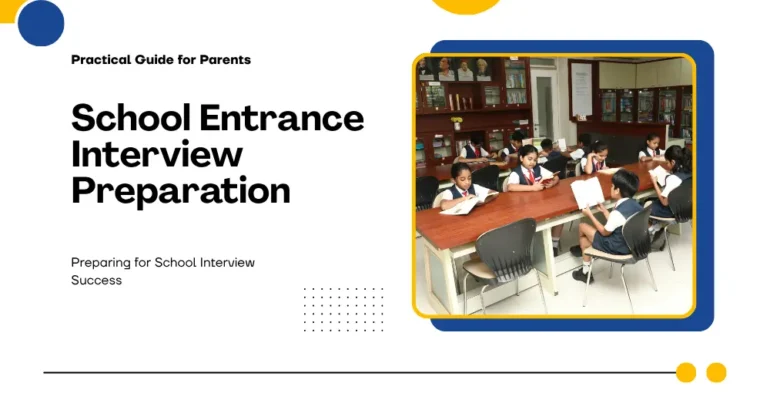
School Entrance Interview Preparation: A Calm, Practical Guide for Parents
 Admin
Admin The admissions email arrives, and there it is: a date and time for your child’s “interaction.” Suddenly every parent in the WhatsApp group has advice. Should you drill flashcards? Buy a workbook? Practise “What is your name?” fifty times in the car?
Take a breath. Good school entrance interview preparation is far gentler, and far more effective, than most parents expect. This guide walks you through what really happens, what schools are looking for, and how to help your child walk in feeling calm.
The short answer: School entrance interview preparation is mostly about familiarity and calm, not coaching. For young children, a school “interview” is usually an informal, play-based interaction where teachers observe how your child communicates, follows simple instructions and approaches new tasks. Older children may sit a short assessment in English, Maths and Science that checks understanding rather than memorised answers. The best preparation is a good night’s sleep, a relaxed morning, a few conversations about what the day will look like, and a parent who stays positive. Avoid drilling scripted answers: teachers can tell, and it often makes children more anxious. Prepare yourself too, because many schools also chat with parents about their child and their expectations.
Below, this school entrance interview preparation guide covers what to expect on the day, the questions children and parents are commonly asked, age-wise tips, a one-week checklist and the mistakes worth avoiding.
What Is a School Entrance Interview, Really?
The word “interview” makes it sound formal, but at most good schools it is closer to a structured conversation. Understanding that is the first step in school entrance interview preparation. The school wants to understand three things: whether your child is ready for the grade, how they learn, and whether the school is the right fit for your family.
For preschool and the early primary years, teachers watch how a child plays, listens, shares and responds to a friendly adult. For older children, there may be a written or oral assessment, usually in English, Maths and Science, aimed at understanding how they think. If you are still deciding on timing for a younger child, our guide on whether your child is ready for preschool is a useful starting point, along with the age criteria for school admissions in Mumbai.
Are school admission interviews allowed in India?
It is a fair question. Section 13 of the Right of Children to Free and Compulsory Education Act, 2009 bars schools from using screening procedures, such as tests or interviews of the child or parents, when admitting children aged 6 to 14, and it also bans capitation fees. The Government of India’s admission guidelines under the RTE Act spell this out. For nursery admissions in private unaided schools, the Delhi High Court has held that these screening guidelines do not apply to the general (unreserved) seats, as this PRS Legislative Research summary explains. In practice, many schools describe their process as an “interaction” or “orientation” rather than a test. If you are unsure, ask the school how its process works and how decisions are made.
What to Expect on the Day
Knowing the format is half of your school entrance interview preparation. Every school runs things a little differently, but most entrance interactions follow a familiar pattern:
- Arrival and registration. You check in, often with documents such as a birth certificate and recent photographs.
- A short wait. Children may be taken to a play area or classroom while parents wait nearby.
- The child’s interaction. For young children, this is usually 10 to 20 minutes of activities: puzzles, picture cards, drawing, stacking blocks or a short story.
- An assessment for older grades. From around Grade 5 onwards, many schools give a short paper or oral check in core subjects.
- A conversation with parents. The admissions team or a coordinator may ask about your child, your expectations and why you chose the school.
- Questions from you. Most schools end by inviting your questions. Use this time well.
School Entrance Interview Preparation by Age
School entrance interview preparation looks different at every stage. Match your approach to your child’s age.
Preschool and Kindergarten (ages 2.5 to 5)
At this age, the focus is comfort with a new adult and a new space. Play simple sorting and naming games, read picture books together and practise taking turns. Let your child spend short periods with another trusted adult so separation feels normal. Never coach answers; a three-year-old who says “I don’t know” is perfectly fine.
Early primary (Grades 1 to 4)
Children this age benefit from talking about their own interests in full sentences. Ask open questions at dinner: “What was the best part of your day, and why?” Keep reading aloud daily, and play counting and word games in the car or kitchen. School entrance interview preparation here means building confidence in conversation, not memorising facts.
Middle years and above (Grade 5 onwards)
If the school mentions an entrance assessment, ask which subjects it covers and at what level. For this age group, school entrance interview preparation can include light revision of core concepts in English, Maths and Science helps, and a few short revision techniques make that time more effective.
Entrance assessment tips for older students
- Read every question twice before answering.
- Show your working in Maths; teachers look at how you think.
- If you are stuck, move on and come back later.
- It is fine to say “I haven’t learnt that yet, but I think it might be…”
If your child tends to get anxious before tests, our guide to managing exam stress has practical calming strategies.
Common Questions Asked in a School Interview
The questions asked in a school interview are rarely tricky, so school entrance interview preparation should never mean memorising answers. Here is a sample set so you know roughly what to expect.
Questions for young children (preschool to Grade 2)
- What is your name? How old are you?
- What colour is this? How many blocks can you count?
- Can you tell me about this picture?
- What do you like to play with at home?
- Who is in your family?
Questions for older children (Grade 3 and above)
- What do you enjoy learning about, and why?
- Tell me about a book you liked recently.
- What do you do when you find something difficult?
- What are your hobbies outside school?
- Why would you like to join this school?
Questions schools often ask parents
- How would you describe your child?
- Why are you considering this school and this curriculum?
- How do you support learning at home?
- Does your child have any needs we should know about?
Answer honestly. Schools appreciate parents who describe their child as they really are, strengths and struggles included.
The Week Before: Your Preparation Checklist
Use this simple checklist to keep your school entrance interview preparation organised without adding pressure:
- Confirm the details: date, time, venue and anything the school has asked you to bring.
- Gather documents: birth certificate, photographs, previous report cards and any forms requested.
- Plan the journey: Mumbai traffic is unpredictable, so do a trial run or leave a generous buffer.
- Protect sleep: shift bedtime earlier if needed. Rest matters more than revision, as our article on sleep and exam performance explains.
- Talk about the day: describe it in a light, positive way: “You’ll meet a teacher and play some games.”
- Choose comfortable clothes: neat and comfortable beats formal and stiff.
- Prepare your own questions: write down what you want to know about the school.
The American Academy of Pediatrics suggests visiting a new school beforehand and talking through any worries, which is just as useful for school entrance interview preparation in the days before an interaction.
On the Day: Tips for Parents
Your mood travels straight to your child. A few habits make a big difference:
- Keep the morning ordinary. A normal breakfast, no last-minute quizzing.
- Arrive early but not too early. Ten to fifteen minutes is ideal; long waits build nerves.
- Stay warm and neutral. Say “Have fun!” rather than “Make sure you answer properly.”
- Let your child speak. Resist the urge to answer for them or correct them in front of the teacher.
- Don’t ask “How did it go?” immediately. Talk about something enjoyable instead; children share more when they feel relaxed.
Treat the day as the final step of your school entrance interview preparation, not a test of it. Whatever happens in the room, your calm presence afterwards is what your child will remember.
Common Mistakes in School Entrance Interview Preparation
Most mistakes in school entrance interview preparation come from love and worry. Watch out for these:
- Over-coaching. Rehearsed answers sound unnatural and can make children freeze when the question is phrased differently.
- Turning it into a test. Phrases like “If you don’t do well, you won’t get in” put heavy pressure on young shoulders.
- Cramming the night before. Tired children perform worse than rested ones.
- Comparing with siblings or friends. Every child shows their strengths differently.
- Over-preparing yourself. Parents who sound scripted can come across as anxious. Be yourself.
- Skipping your own homework. Not researching the school means missing the chance to ask useful questions.
What If Your Child Freezes, Cries or Won’t Talk?
It happens far more often than parents think, and experienced teachers expect it. A shy child, an upset child or a child who goes completely silent is not an automatic “no.” Teachers are trained to give children time, try a different activity or come back to a task later.
If your child becomes upset, stay calm and follow the teacher’s lead. Some schools will invite you to sit nearby or offer to reschedule. Afterwards, reassure your child that they did nothing wrong. Part of school entrance interview preparation is quietly preparing yourself for this possibility, so it doesn’t rattle you if it happens.
If you are worried that ongoing anxiety is affecting your child, speak with your paediatrician or the school counsellor for guidance.
How Panbai Approaches the Admissions Interaction
At Panbai International School in Santacruz East, admissions follow five clear steps: an online enquiry, a conversation with the admissions counsellor, a school visit, an interaction with the child and then the admission decision. Our admissions process guide explains each step in detail.
For the primary years, the interaction is informal and activity-based. Teachers simply get to know your child: their readiness, how they communicate and how they approach learning. It is not a test of knowledge. From Grade 5 onwards, there is an assessment in English, Maths and Science designed to understand conceptual thinking rather than rote recall. Admissions at Panbai are not influenced by donations, and the school does not work through agents.
If you are doing your school entrance interview preparation for Panbai, bring your questions when you visit. These 10 questions to ask an international school in Mumbai are a good place to start. If you are looking for a top international school in Mumbai with a complete Cambridge pathway from preschool to A Levels, visit our admissions page to book a conversation with our counsellor.
Frequently Asked Questions
How do I prepare my child for a school interview?
Keep it light. Read together, play simple games, talk about the day in a positive way and protect sleep the night before. Good school entrance interview preparation builds familiarity and confidence rather than drilling answers.
What questions are asked in a school admission interview?
Young children are usually asked simple questions about their name, colours, numbers, pictures and favourite activities. Older children may be asked about their interests, books they enjoy and how they handle challenges. Parents are often asked about their child and why they chose the school.
How long does a school entrance interview last?
For young children, the interaction typically lasts 10 to 20 minutes. Assessments for older students and conversations with parents can take longer, so allow around an hour in total.
Should I coach my child with answers?
No. Scripted answers often sound unnatural and can make children nervous if a question is phrased differently. Teachers want to see your child as they really are, so keep school entrance interview preparation natural.
What if my child doesn’t speak during the interview?
Stay calm. Teachers see shy and silent children regularly and usually try different activities or give extra time. A quiet interaction does not automatically mean your child won’t be offered a place.
Final Thoughts
The best school entrance interview preparation is not a crash course. It is a week of good sleep, relaxed conversations and a parent who treats the day as a chance to explore a school together. Teachers are not looking for perfect answers; they are looking for a curious child who feels safe enough to be themselves.
So close the workbook, read a story tonight and remind your child that whatever happens, you are proud of them. With calm, simple school entrance interview preparation, both of you will walk in ready.
