
How to Study for IGCSE Exams: A Complete Revision Guide for Students
September 16, 2026 2026-09-16 23:29How to Study for IGCSE Exams: A Complete Revision Guide for Students
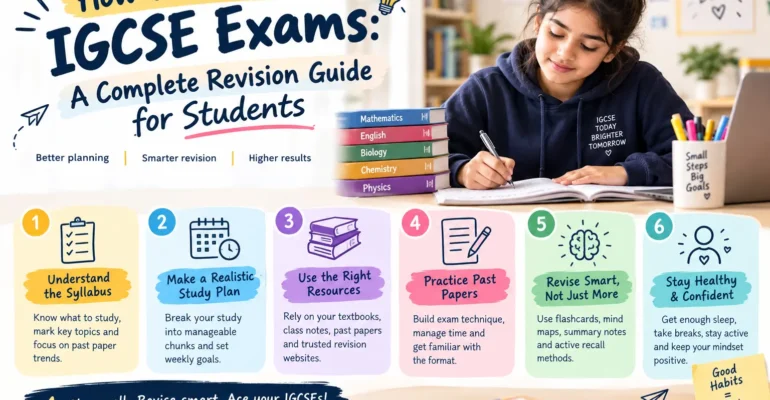
How to Study for IGCSE Exams: A Complete Revision Guide for Students
 Admin
Admin If you’ve typed “how to study for IGCSE exams” into Google at 11 pm with a stack of untouched notes beside you, you’re not alone. Every year, thousands of students preparing for their Cambridge or Edexcel IGCSE exams feel the same mix of pressure and confusion — too many subjects, too little time, and no clear plan.
The good news? Doing well in your IGCSEs isn’t about studying for longer hours than everyone else. It’s about studying smarter, using techniques backed by cognitive science, and building a routine you can actually stick to. This guide breaks down exactly how to study for IGCSE exams — from understanding your syllabus to building a revision timetable, mastering active recall, and tackling subject-specific challenges.
Why a Study Plan Matters More Than Willpower
Most students don’t fail IGCSE exams because they didn’t try hard enough. They fail because they revised the wrong way — re-reading notes, highlighting textbooks, and hoping information “sinks in.” These passive methods feel productive but rarely translate into exam marks.
Learning how to study for IGCSE exams effectively means shifting from passive revision to active, structured practice. That shift alone is often the difference between a C and an A grade.
Step 1: Know Your Syllabus Before You Open a Textbook
Before you revise a single topic, get the official syllabus for each of your subjects from your exam board — Cambridge International, Pearson Edexcel, or Oxford AQA. The syllabus tells you precisely what can and cannot come up in your exam, so you stop wasting hours on content you’ll never be tested on.
A simple way to use it:
- Print the topic list for each subject
- Mark each topic green (confident), amber (shaky), or red (don’t understand yet)
- Prioritise red topics first, since they carry the biggest risk
This single step turns a vague “I need to study for IGCSE exams” feeling into a concrete, trackable checklist.
Step 2: Gather the Right Resources
Not every resource is worth your time. Focus on:
- Past papers and mark schemes — the single most realistic way to practise exam conditions
- Examiner reports — these reveal exactly where students consistently lose marks
- Syllabus-specific revision notes — concise, board-matched summaries rather than generic notes
- Topic-wise question banks — to drill one skill at a time before attempting full papers
Aim for a minimum of three to five years of past papers per subject, and treat the mark scheme as seriously as the question paper itself — it teaches you how marks are awarded, not just what the right answer is.
Step 3: Build a Revision Timetable You’ll Actually Follow
A realistic timetable beats an ambitious one you abandon after three days. When planning how to study for IGCSE exams over several months, structure your time in phases:
12–9 weeks before exams (Foundation phase): Complete your syllabus audit, tackle red-flagged topics first, and start creating flashcards and summary sheets.
8–5 weeks before exams (Consolidation phase): Move to amber topics, begin full past papers (one per subject per week), and start timed practice.
4–2 weeks before exams (Intensification phase): Full past papers under strict exam conditions, focused entirely on weak areas your practice has revealed.
Final week: Light review only — flashcards, summary sheets, sleep, and equipment prep. Cramming new content this close to an exam rarely helps and often increases anxiety.
Mix subjects within each week rather than blocking one subject for days at a stretch — this keeps revision sessions interesting and mirrors how your brain will need to switch between subjects on exam day.
Step 4: Use Active Revision Techniques, Not Passive Ones
This is the core of learning how to study for IGCSE exams efficiently. Three techniques consistently outperform re-reading and highlighting:
Active Recall
Instead of reading your notes, close them and try to write down everything you remember. Use flashcards, the “blank page” technique (write a topic title and dump everything you know from memory), or explain a topic aloud to someone else. The mental effort of retrieving information — rather than recognising it — is what builds long-term memory.
Spaced Repetition
Review new material after one day, then three days, then a week, then a month. Spacing sessions out, rather than cramming, keeps information in your long-term memory far more reliably. Apps like Anki or Quizlet build this spacing in automatically.
Interleaving
Mix subjects within a single study session instead of grinding through one topic for hours. For example, 30 minutes of Maths, then Biology, then back to Maths. It feels harder in the moment, but that extra effort is exactly what strengthens recall — particularly useful for problem-solving subjects like Maths and Physics.
Step 5: Practise Past Papers Early and Often
If you do only one thing consistently, make it this. Past papers are the closest simulation of your actual exam. Work through questions under timed conditions, mark them strictly against the official mark scheme, and track recurring mistakes rather than just your overall score. In the final month, compile every question you’ve gotten wrong across multiple papers and drill that specific weak spot until it disappears.
Subject-Specific Study Strategies
Not every subject responds to the same revision method.
- Maths: A skill subject, not a memory subject. Practise problems daily, always show full working for method marks, and time yourself to build exam speed.
- Sciences (Biology, Chemistry, Physics): Combine flashcards for definitions with repeated diagram practice, since many marks come from clearly labelled diagrams and calculation method marks.
- English Language and Literature: Build vocabulary through wide reading, practise timed comprehension, and use short, embedded quotations in analysis answers.
- Humanities (History, Geography, Economics): Create timeline or diagram summaries, and practise structuring essays — “define, explain, evaluate” — under timed conditions.
Step 6: Protect Your Wellbeing While You Study
Effective revision isn’t about exhausting yourself. Sleep 8–9 hours a night — this is when memories consolidate. Build in 30 minutes of daily movement, use the Pomodoro technique (25 minutes of focus, 5-minute break) to avoid burnout, and don’t isolate yourself completely; talking to classmates or a study group keeps motivation up during a long revision season.
How Panbai International School Supports IGCSE Students
Knowing how to study for IGCSE exams on paper is one thing — having the right environment, teachers, and structure around you makes it far easier to actually follow through. At Panbai International School, IGCSE students get subject specialists who map revision directly to the Cambridge and Edexcel syllabus, regular past-paper practice built into the term calendar, and structured mock exam cycles that mirror real exam conditions well before the final papers. Instead of leaving revision technique to chance, teachers actively coach active recall, spaced repetition, and exam-answering technique inside the classroom — so students walk into their IGCSEs having already practised the process, not just the content. If you’re evaluating options, it’s worth exploring some of the best IGCSE schools in Mumbai to see how structured support during these two years can shape results.
Frequently Asked Questions
What grade is 70% in IGCSE?
As a general rule, 70% typically falls into the B grade range (grade boundaries are usually A* 90%+, A 80–89%, B 70–79%, C 60–69%), though exact boundaries shift slightly by subject and exam session, so always check the boundaries published for your specific paper.
How do you get an A* in IGCSE?
Consistent past-paper practice (aim for 5+ years per subject), disciplined use of active recall and spaced repetition, close study of mark schemes and examiner reports to understand exactly how marks are awarded, and starting revision months rather than weeks before the exam.
Can IGCSE students crack IIT?
Yes. IGCSE students are eligible for JEE Main and JEE Advanced (the entrance exams for IITs) provided they meet the board’s standard eligibility criteria, such as required subject combinations and minimum aggregate marks. Many IGCSE students do successfully get into IITs with focused JEE preparation alongside their board studies.
Is IGCSE easy or hard?
IGCSE is designed to be rigorous but fair — difficulty depends heavily on the individual student’s strengths, the subjects chosen (Core vs Extended tier), and preparation quality. Science and Maths subjects are generally considered more demanding due to dense syllabi and problem-solving requirements.
Is IGCSE harder than CBSE?
The two aren’t directly comparable, since IGCSE emphasises analytical and application-based skills through varied assessment formats, while CBSE leans more on structured, memory-based question patterns. Many educators consider IGCSE conceptually broader, but CBSE’s syllabus can be equally demanding in volume.
What are the top 10 hardest IGCSE subjects?
Subjects most commonly cited as challenging include Mathematics (Extended), Additional Mathematics, Physics, Chemistry, Biology, Foreign Languages (including Latin and Mandarin), Computer Science, Economics, English Literature, and Art & Design — largely due to dense syllabi, abstract concepts, or heavy analytical demands.
What if I fail science in GCSE/IGCSE?
Most schools and exam boards allow resits in the next available exam series. It’s also worth speaking with your school about targeted support or tutoring on the specific topics that caused the lowest marks before attempting a resit.
Final Thoughts
Learning how to study for IGCSE exams isn’t about finding one secret trick — it’s about combining a realistic timetable, the right resources, and active revision techniques like recall and spaced repetition, then protecting your energy along the way. Start early, track your weak areas honestly, and let past papers do most of the heavy lifting in your final months. Progress compounds — and with the right structure, strong grades are absolutely within reach.