


Is an International School Worth It in Mumbai? An Honest Answer for Parents
June 26, 2026 2026-06-26 12:31Is an International School Worth It in Mumbai? An Honest Answer for Parents
Is an International School Worth It in Mumbai? An Honest Answer for Parents
 Admin
Admin If you have found yourself Googling “is an international school worth it in Mumbai” at 11 pm while staring at a fee brochure, you are not alone. This is one of the most common questions Mumbai parents wrestle with — and one of the least honestly answered.
Most school blogs will give you a cheerful list of ten benefits and call it a day. This one will not. We will walk through the real costs, the genuine advantages, the situations where an international school makes complete sense, and the situations where it might not. By the end, you should have a clear enough picture to make this decision with confidence — not anxiety.
What Do Parents in Mumbai Actually Mean When They Ask This Question?
When a parent asks “is an international school worth it in Mumbai?”, they are rarely asking about curriculum theory. They are usually asking one of three specific things:
- Is the fee justified? Annual fees at international schools in Mumbai typically range from ₹2 lakh to ₹8 lakh per year for Cambridge IGCSE schools, and can go significantly higher for IB schools. That is a substantial, decade-long financial commitment.
- Will my child get into a good college? Indian parents — reasonably — want to know whether an international curriculum opens more doors or fewer.
- Is it actually better than a good CBSE school? This is the honest version of the question, and it deserves an honest answer.
Let us take each of these head-on.
The Real Cost of an International School in Mumbai
Before weighing benefits, it helps to understand the full financial picture — because the tuition figure on the brochure is rarely the complete story.
Tuition Fees: What to Expect
In Mumbai, international schools can broadly be categorised across fee bands. Budget to mid-range Cambridge schools typically charge ₹1,80,000 to ₹3,50,000 per year at the primary level, while established mid-tier international schools range from ₹4,00,000 to ₹7,00,000. Premium IB schools at the higher end can charge ₹9,00,000 to ₹15,00,000 or more annually.
For Cambridge IGCSE specifically — which is the curriculum followed by schools like Panbai International School — fees tend to sit in the more accessible mid-range, making it one of the more financially sustainable pathways to international education in the city.
The Hidden Costs Parents Often Overlook
Tuition is just the starting point. A realistic annual budget should also account for:
- One-time admission fees: Typically ₹25,000 to ₹1,00,000, non-refundable
- Transport: AC school buses with GPS can add ₹30,000 to ₹60,000 per year
- Cambridge exam fees: Board examinations (IGCSE, A Levels) are charged separately and can add ₹1,00,000 or more per exam session
- Devices and stationery: Many international schools require tablets or specific laptops from Grade 7 upward
- Extracurricular and enrichment programmes: Competitions, exchange programmes, and immersion trips are usually charged separately
The honest takeaway: always ask for the total annual cost of attendance, not just the tuition figure, before making a decision.
International School vs Regular School in Mumbai: What Is Actually Different?
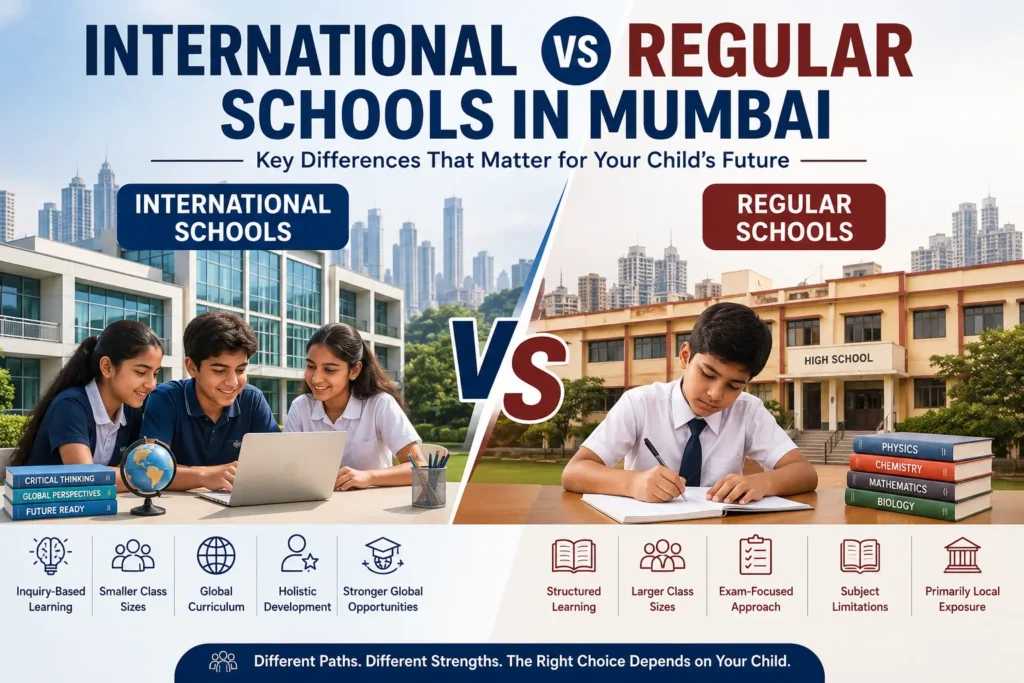
This is where most articles get vague. Here is a concrete comparison.
How Teaching Actually Differs
In a conventional CBSE classroom, the primary question is often “what happened?” — students learn content, memorise it, and reproduce it in exams. In a Cambridge IGCSE classroom, the question shifts to “why did this happen, and how does it connect to something else?”
The core philosophy of international boards is inquiry-based learning — the focus is on developing critical thinking, problem-solving, and genuine curiosity. Students are not just memorising definitions of complex scientific terms; they are designing experiments to understand them.
This is not a subtle difference. It fundamentally changes how a child learns to think — and that difference compounds over years.
The Student-Teacher Ratio Advantage
One of the most measurable differences between an international school and a regular school in Mumbai is classroom size. International schools typically maintain student-to-teacher ratios of 1:12 to 1:15 in secondary school. Many government-affiliated schools in Mumbai operate at ratios of 1:30 or higher. This matters not because teachers in larger classrooms are less skilled, but because individualised attention at scale is simply not possible without smaller classes.
Curriculum Breadth and Subject Choice
A student in a conventional board has limited subject flexibility. A Cambridge IGCSE student typically chooses from 70+ subjects across five curriculum groups — allowing them to build a combination that reflects their actual strengths and interests, rather than following a fixed stream. This breadth is particularly valuable for students who do not fit neatly into “science” or “commerce” categories.
Extracurricular Integration, Not Addition
In many traditional schools, extracurricular activities exist alongside academics — scheduled separately, treated as secondary. In well-run international schools, activities like Model UN, robotics, community service, and the arts are structured into the curriculum itself. For Cambridge schools, the co-curricular component is assessed and recognised, not optional decoration.
The Benefits of an International School in Mumbai: What the Data Says
1. University Placement Results Are Measurably Better for Global Admissions
If your child has any possibility of pursuing higher education abroad, an international curriculum is not just helpful — it is almost necessary. Cambridge IGCSE and A Levels are recognised by over 2,000 universities across 160 countries, including every major institution in the UK, US, Canada, and Australia. According to ISC Research, India now has over 900 international schools offering IB and Cambridge curricula — a number that reflects genuine, sustained demand, not a passing trend.
For parents who want to keep both options open — Indian colleges and international universities — the Cambridge pathway is particularly effective because A Level grades are accepted by Indian universities under the Association of Indian Universities (AIU) equivalency framework.
2. Critical Thinking Skills That Last Beyond School
A 2025 Harvard University study found that students using inquiry-based and AI-supported learning approaches learned more than twice as much in less time compared to those in traditional learning environments. The Cambridge curriculum’s emphasis on analysis, source evaluation, and extended writing mirrors the kind of independent thinking that universities — and employers — increasingly look for.
3. Smaller Classes Mean Gaps Do Not Go Unnoticed
In a class of 30, a child who is struggling in one subject can go unnoticed for weeks before a teacher catches it. In a class of 12 to 15, that gap surfaces within days. This is not just an anecdotal advantage — it is the reason why international schools consistently report stronger learning outcomes per student, even when intake profiles are similar to conventional schools. You can read more about the specific advantages this creates across subjects.
4. Global Mindset Built Into Daily Learning
Subjects like Global Perspectives — introduced from the Cambridge Primary years — ask students to examine real-world issues from local, national, and global viewpoints. Students who grow up debating climate policy or economic inequality in a structured classroom setting develop a kind of contextual intelligence that a purely exam-driven curriculum rarely produces.
5. Teacher Quality and Continuous Development
International schools are mandated by Cambridge Assessment International Education (CAIE) to ensure their teachers undergo regular, subject-specific Cambridge training. This is not optional professional development — it is a condition of maintaining CAIE affiliation. The result is a faculty that understands how the curriculum is assessed, not just what it contains.
When an International School in Mumbai Is the Right Choice
An international school in Mumbai makes clear sense when:
- Your child may study abroad — either for undergraduate or postgraduate education
- You value inquiry over rote learning — and want a child who thinks, not just memorises
- You want subject flexibility — particularly if your child has varied strengths across science, arts, and humanities
- You are in it for the long term — starting from primary school so the child grows into the curriculum, rather than switching mid-way
- You want continuity — a school that offers the full Cambridge pathway from primary through IGCSE to A Levels, so there are no disruptive board changes during critical years
When It May Not Be the Right Fit
Honesty requires saying this too. An international school in Mumbai may not be the best choice if:
- Your child’s goal is specifically to crack JEE or NEET for engineering or medicine in India — for these, CBSE’s alignment with the national exam syllabus is a genuine advantage
- The fees would require over-leveraging your finances — the pressure on a child to “perform” to justify significant family expense can counteract the very stress-free learning environment that international schools promise
- You are considering switching your child in Grade 9 or 10 — late curriculum transitions are hard on students and rarely produce the results parents hope for
What to Look For When Choosing an International School in Mumbai
Not all international schools are equal, and the label alone tells you nothing. Here is what actually separates a school that delivers on its promises from one that does not.
Check CAIE Affiliation, Not Just Claims
Any school calling itself a “Cambridge school” should be verifiably affiliated with Cambridge Assessment International Education. You can check this directly on the CAIE school search portal. Affiliation means the school is subject to external inspection and curriculum compliance — not just marketing.
Ask About the Full Pathway
If a school only offers IGCSE from Grade 9 but does not have its own A Level programme, your child will need to change schools after Grade 10 — a significant disruption. A school that offers the complete Cambridge pathway from primary through A Levels provides continuity that has real academic and emotional value. Explore the benefits of this kind of continuous international schooling before making your decision.
Look at University Destination Data
A credible international school should be able to show you where recent graduates have been accepted — not just logos on a website, but actual cohort data. Ask for the last two or three years of university placement records.
Visit During a School Day, Not an Open Day
Open days are curated. A school day visit shows you the actual classroom environment, how students interact with teachers, and whether the learning culture the school describes actually exists in practice.
How Panbai International School Fits Into This Picture
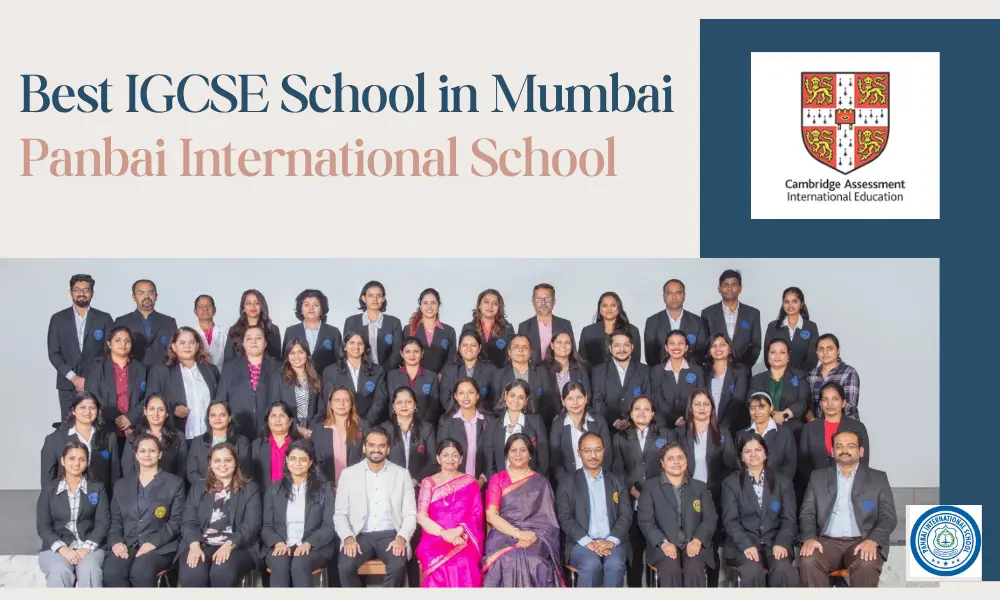
For parents in Mumbai’s western suburbs — particularly around Santacruz, Bandra, Juhu, and Andheri — Panbai International School is one of the few options that genuinely ticks all the boxes outlined above.
Panbai is a CAIE-affiliated internationally recognised school in Mumbai that offers the full Cambridge pathway: Cambridge Early Years and Primary, Cambridge Lower Secondary, IGCSE, and Cambridge A Levels — all under one roof. Students who start at Panbai do not need to change schools at any point in their academic journey.
The school maintains a 15:1 student-to-teacher ratio, has a verified track record of university admissions to institutions in the UK, US, Canada, and India, and integrates co-curricular development — including Global Perspectives, leadership programmes, and arts — into the core school experience, not as optional extras.
For parents asking whether an international school in Mumbai is worth it, the more precise question is: which international school, and does it actually deliver what it promises? That is the question worth spending time on.
Frequently Asked Questions
Is an international school in Mumbai worth the fees?
For families where higher education abroad is a goal, or where a child’s learning style fits better with inquiry-based education, the investment in a Cambridge or IB international school in Mumbai is generally worth it. The key is choosing a school that has genuine CAIE or IB affiliation, a strong university placement track record, and a stable full-pathway programme — rather than paying premium fees for a school that offers international branding without the substance.
What is the fee range for international schools in Mumbai?
Fees vary widely depending on the school and curriculum. Cambridge IGCSE schools in Mumbai typically range from ₹2 lakh to ₹5 lakh per year, while IB schools can go significantly higher. Beyond tuition, parents should budget for one-time admission fees, Cambridge exam fees, transport, and devices. Always ask for the total cost of attendance, not just the annual tuition figure.
Is IGCSE better than CBSE for Mumbai students?
It depends on your child’s goals. If your child is targeting JEE or NEET for engineering or medicine in India, CBSE’s alignment with those exams is a genuine advantage. If your child may study abroad or benefits from a more inquiry-driven, flexible curriculum, Cambridge IGCSE is the stronger choice. The two boards are not interchangeable — they reflect different educational philosophies, not just different exam patterns.
Can an IGCSE student get into Indian colleges?
Yes. Cambridge IGCSE and A Level qualifications are recognised by the Association of Indian Universities (AIU), making graduates eligible for admission to Indian colleges and universities. However, eligibility for specific programmes — particularly medicine and engineering — depends on individual university requirements, so it is worth verifying with the target institution.
At what age should I enroll my child in an international school in Mumbai?
The earlier, the better — but for practical reasons, not just philosophical ones. A child who enters a Cambridge school at the primary level grows up with the curriculum’s approach to learning: asking questions, investigating, explaining reasoning. A child who switches from CBSE to Cambridge in Grade 9 must adapt to a completely different assessment style under exam pressure. If international education is the plan, starting early makes the experience significantly smoother.
What should I ask when visiting an international school in Mumbai?
Ask about CAIE affiliation verification, the full curriculum pathway offered, student-to-teacher ratios, Cambridge-trained faculty numbers, university placement data for the last three years, and the total annual cost of attendance including exam fees, transport, and devices. A school that answers all of these transparently is one worth considering. One that deflects or generalises is worth approaching carefully.
How is an international school different from a regular school in Mumbai?
The core difference is the approach to learning. International schools following the Cambridge or IB framework use inquiry-based teaching — students are expected to question, investigate, and analyse rather than memorise and reproduce. Class sizes are smaller, subject choice is broader, co-curricular activities are integrated rather than optional, and the qualification is globally recognised. A regular Mumbai school affiliated to CBSE or ICSE offers a rigorous curriculum too, but with a different pedagogical approach and primarily national recognition.
