


What Makes a School Truly the Best International School in Mumbai? 7 Things Parents Should Check
July 22, 2026 2026-07-20 16:24What Makes a School Truly the Best International School in Mumbai? 7 Things Parents Should Check
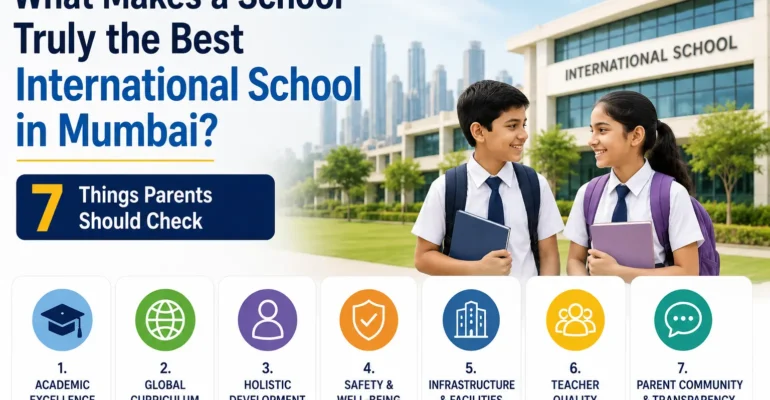
What Makes a School Truly the Best International School in Mumbai? 7 Things Parents Should Check
 Admin
Admin Mumbai has over 150 schools that describe themselves as “international.” They have modern websites, impressive-sounding curricula, and open day presentations that leave parents feeling inspired. And yet, two years into their child’s education, many of those same parents realise the gap between what a school promised and what it actually delivers.
The word “international” in a school’s name is not a quality certification. It is a marketing descriptor. What actually makes a school the best international school in Mumbai — genuinely, not in a brochure — comes down to seven verifiable things. Not claims. Not photographs. Things you can check, ask for, and confirm before you commit.
This guide walks through all seven. By the end, you will have a working checklist that cuts through the noise and focuses your shortlisting on what actually produces outcomes.
Why Most Parents Evaluate Schools the Wrong Way
Before the checklist, it is worth understanding the most common evaluation mistake Mumbai parents make: they visit schools in the order they hear about them most, and they judge based on what they see in 45 minutes on an open day.
Open days are presentations. The classrooms are tidy, the teachers are on their best behaviour, the student ambassadors are the most confident in the school. None of this tells you whether your child will receive genuine individual attention in a normal week, whether the career counselling actually starts early enough to matter, or whether the Cambridge results are consistently strong or occasionally so.
The seven criteria below require you to ask direct questions, request specific data, and verify claims independently. A school that meets all seven genuinely — not just on paper — is almost certainly the best international school in Mumbai for your child.
1. Verified CAIE Affiliation — Not Just a Cambridge Label
What to check: Is the school listed on the Cambridge Assessment International Education school finder at cambridgeinternational.org?
This is the first and most non-negotiable criterion. Any school can print “Cambridge curriculum” on its marketing materials. CAIE affiliation is different — it requires the school to meet Cambridge’s curriculum delivery standards, submit to ongoing compliance monitoring, and use only Cambridge-certified assessment frameworks.
Visit the CAIE school finder and search for the school by name. If it is not listed, the school is not a Cambridge school regardless of what its brochure says. If it is listed, check which programmes are affiliated — some schools have Primary affiliation but not IGCSE, or IGCSE but not A Levels.
Why it matters: The Cambridge IGCSE and A Level qualifications your child earns are issued by CAIE — a qualification from a genuinely affiliated school is recognised by over 2,000 universities in 160 countries. A qualification from a school using the Cambridge name without affiliation is not.
What Panbai’s record shows: Panbai International School holds verified CAIE affiliation across Cambridge Primary, Cambridge Lower Secondary, Cambridge IGCSE, and Cambridge AS and A Levels. This is the full affiliation spectrum — not a partial one.
2. A Complete Pathway — From Early Years to A Levels, Under One Roof
What to check: Does the school offer the full Cambridge pathway from primary through to A Levels, or only part of it?
This is the criterion that most Mumbai parents ask last, but should ask first. A school that offers IGCSE from Grade 9 but does not have its own A Level programme means your child will face a school change at Grade 10 — precisely when they are preparing for the most important examinations of their secondary education. A school that starts at Grade 1 but not at preschool means an early transition. Each of these disruptions has a real cost in terms of continuity, social adjustment, and academic momentum.
The best international school in Mumbai for your child is not just the school that is good for the next two years — it is the one where your child can complete their entire academic journey without the disruption of changing schools mid-way.
Why it matters: Curriculum continuity compounds. A child who has learned the Cambridge way of thinking from Grade 1 is in a fundamentally different position at IGCSE than one who joined in Grade 9. The skills — inquiry, analysis, source evaluation, independent research — are built over years, not months.
What Panbai’s record shows: Panbai offers Finnish pedagogy at the Early Years level through Flamingo Kids Preschool, followed by Cambridge Primary (Grades 1–4), Cambridge Lower Secondary (Grades 5–8), Cambridge IGCSE (Grades 9–10), and Cambridge AS and A Levels (Grades 11–12). A child who joins Panbai at Playgroup does not need to change schools at any point through Grade 12. You can explore what this continuous international school journey produces before making your decision.
3. Faculty Qualifications and Cambridge-Specific Training
What to check: What percentage of teachers hold advanced degrees? Have they completed Cambridge-specific teacher development programmes?
Teacher quality is the single most important variable in any school’s outcomes — more important than infrastructure, more important than the curriculum framework, more important than class size. A well-designed curriculum taught by an unprepared teacher produces worse results than a simpler curriculum taught brilliantly.
For Cambridge schools specifically, there is an additional qualification layer beyond general teaching experience. Cambridge subjects have specific assessment approaches — extended writing, source analysis, practical work, portfolio components — that require teachers who have been trained in Cambridge’s particular methodology, not just their subject area. Ask each school specifically: what Cambridge professional development programmes have their teachers completed?
Why it matters: CAIE requires affiliated schools to maintain faculty training standards, but the quality of implementation varies enormously. A school where 90%+ of educators hold advanced degrees and have completed Cambridge-specific development programmes is a materially different learning environment from one where this is the exception.
What Panbai’s record shows: 92% of Panbai’s educators hold advanced degrees — a verifiable, specific figure, not a general claim about “experienced faculty.” Cambridge-specific teacher training is standard practice at the school, not an occasional professional development exercise.
4. Student-to-Teacher Ratio — The Number That Determines Individual Attention
What to check: What is the student-to-teacher ratio in secondary school specifically — not the headline number, but the actual class size in Grade 8, 9, and 10?
This is one of the most important numbers in a school’s entire profile, and one of the least prominently displayed. Small class sizes are not a luxury feature — they are the mechanism by which individual attention actually happens. In a class of 30 students, a teacher delivering a 45-minute lesson has, on average, 90 seconds of individual interaction time per student per class. In a class of 15, that doubles. Over years, the cumulative difference is enormous.
For Cambridge IGCSE specifically, where essays, extended responses, and analytical tasks require substantive feedback rather than just right-or-wrong marking, the teacher’s ability to engage with each student’s specific thinking is what separates good results from excellent ones.
Why it matters: A 15:1 ratio versus a 25:1 ratio in a Cambridge IGCSE class is not a marginal difference. It determines whether your child’s misconceptions are caught and corrected in Grade 9 or discovered during mock exams in Grade 10.
What Panbai’s record shows: Panbai maintains a 15:1 student-to-teacher ratio across the school, including secondary school. This is a verifiable commitment, not a target — and it is significantly lower than the Mumbai city average for secondary schools. Understanding the specific advantages this creates for learning puts this number in practical context.
5. University Placement Track Record — Real Data, Not Logos
What to check: Can the school provide cohort-level university placement data for the last three years — actual destinations, not just institution logos on a wall?
University placements are the most persuasive data point a school can provide — and also the most commonly misrepresented. A school with one alumnus at Oxford and 40 others at unknown institutions will prominently feature the Oxford logo. What you need is the full picture: where did the most recent two or three graduating cohorts actually go, and in what proportions?
Ask specifically for the last three years of A Level or IGCSE graduation destination data, broken down by country and institution type. A school that is proud of its outcomes will share this freely. One that deflects with “we have placed students at top universities globally” is not answering the question.
Why it matters: Placement data is the best available predictor of where your child is likely to end up if they attend the school with similar effort and ability. No other metric tells you this as directly.
What Panbai’s record shows: Panbai’s verified alumni placements include IIT Dharwad (Vedant Wagh, Mechanical Engineering), NMIMS Mumbai (multiple alumni in BBA and B.Com), K. J. Somaiya (Dr. Poorva Malkar, Physiotherapy), Thakur College of Engineering (Kabir Sahani, Electronics and Computer Science), Vellore Institute of Technology (Rishi Nambiar, Computer Engineering), Boston University (USA), Nottingham Trent University (UK), California State University (USA), International Medical University (Malaysia), and ModArt Paris (France). This is cohort-level data, not cherry-picked logos.
6. Structured Career Counselling — Starting Early Enough to Matter
What to check: When does career counselling formally begin? Is it a Grade 10 panic exercise or a multi-year structured programme?
Career counselling is the hidden differentiator between international schools in Mumbai, and almost no school marketing talks about it in specific terms. The reason matters: a school that begins career conversations in Grade 10 gives students approximately six months to make subject choices that will affect their university applications. A school that begins in Grade 7 gives students three years.
The difference shows up everywhere. A student who knows by Grade 8 that they are interested in engineering will choose Physics, Chemistry, and Mathematics at IGCSE and A Level — the right combination for JEE eligibility and UK engineering applications simultaneously. A student who figures this out in Grade 11 may have already foreclosed those options by choosing the wrong IGCSE subjects.
Why it matters: The best international education is not just about what happens in the classroom — it is about the forward planning that determines whether classroom performance translates into the right university outcomes.
What Panbai’s record shows: Panbai’s career counselling programme begins formally from Grade 7 — one of the earliest structured counselling timelines of any school in Mumbai’s western suburbs. By the time students reach IGCSE, subject choices and university pathways are not last-minute decisions. They are the result of years of structured guidance. The school’s dedicated counselling programme is a verified part of the curriculum, not a bolt-on service.
7. Co-Curricular Depth — Integration, Not Decoration
What to check: Are extracurricular activities genuinely integrated into the school programme, or are they optional add-ons that run after hours and most students skip?
The best international school in Mumbai does not treat co-curricular activities as extras. It treats them as part of the educational proposition — the environment in which students develop confidence, leadership, creativity, collaboration, and the kind of real-world experience that university admissions offices globally look for beyond grades.
Ask specifically: which co-curricular programmes are included in the school fees versus charged additionally? Are they run by specialist partners with verified credentials, or by generalist teachers covering an activity? Is student participation tracked and included in the portfolio or school record?
Why it matters: Cambridge universities, US liberal arts institutions, and competitive Indian programmes increasingly evaluate applicants holistically. A student with strong A Level grades and a meaningful co-curricular record is a more competitive applicant than one with the same grades and nothing else. The best international school builds this record as part of the school experience, not as something families arrange separately.
What Panbai’s record shows: Panbai’s co-curricular programme is run by specialist partners with verified professional credentials — not generalist teachers covering multiple roles. Partners include Shiamak Davar Dance Education, Kudo International Federation India (martial arts), Irobo Kids (STEM and AI), Furtados School of Music, Barca Academy (football), Marcos Quay, and Navars Space Labs (Student Satellite Programme). Students from Grade 1 to Grade 5 have access to a free robotics programme. Beyond structured activities, students run the school magazine, podcast, and social media campaigns — real-world leadership experience built into the school day, not scheduled as an optional after-school club.
Putting It Together: A Practical Checklist
When visiting any international school in Mumbai, bring these seven questions and ask for specific answers — not brochure language:
| Check | What to Ask | What a Good Answer Looks Like |
|---|---|---|
| CAIE Affiliation | “Can I verify your CAIE affiliation on the Cambridge school finder?” | Direct yes, with the exact programmes listed |
| Full Pathway | “Does my child’s journey here go from preschool to A Levels without changing schools?” | Yes, with specific grade ranges confirmed |
| Faculty Qualifications | “What percentage of teachers hold advanced degrees and Cambridge training?” | A specific percentage, not “our teachers are experienced” |
| Student-Teacher Ratio | “What is the actual class size in Grade 9 and 10?” | A number under 20 for a genuinely small-class school |
| University Placements | “Can I see where your last three graduating cohorts went, by institution and country?” | A document or page with actual student names and destinations |
| Career Counselling | “In which grade does structured career counselling formally begin?” | Grade 7 or earlier is excellent; Grade 10 is too late |
| Co-Curricular Integration | “Which activities are included in fees, who runs them, and how is participation tracked?” | Named specialist partners, inclusion in school record |
A school that answers all seven clearly and specifically — with evidence, not marketing language — is one worth shortlisting seriously. A school that deflects, generalises, or redirects any of these questions is telling you something important.
How Panbai International School Measures Against All Seven
For parents in Mumbai’s western suburbs evaluating their options, it is worth stating clearly what the evidence shows for Panbai International School in Santacruz East — not as a promotional claim, but as a specific answer to each of the seven criteria above.
Panbai is a CAIE-verified best international school in Mumbai with full affiliation across every Cambridge phase from Primary to A Levels. The school offers the complete pathway from Finnish-pedagogy Early Years through Playgroup, Nursery, KG, Cambridge Primary, Lower Secondary, IGCSE, and A Levels — under one roof in Santacruz East, accessible from Bandra, BKC, Juhu, Andheri, Vile Parle, Dadar, Mahim, and Kalina.
92% of educators hold advanced degrees. The student-to-teacher ratio is 15:1. Career counselling begins from Grade 7. Co-curricular activities are run by named specialist partners. University placement data is verifiable at the cohort level. And the school has been independently ranked as the 4th Best Cambridge School in Mumbai by the Times of India School Survey Awards 2023.
None of these claims require you to take Panbai’s word for them. Every one can be verified — the CAIE affiliation on the Cambridge website, the faculty data from the school directly, the placement data from publicly available alumni records, the ranking from the Times of India. That is what genuine transparency looks like from a school confident in its outcomes.
To begin the admissions enquiry for 2026-27, families can reach Panbai at admissions@panbaiinternationalschool.com, +91 7700096669, or through the online form at panbaiinternationalschool.com/admissions-open/.
Frequently Asked Questions
What should I look for when choosing the best international school in Mumbai?
The seven criteria that most reliably separate genuinely excellent international schools from well-marketed ones are: verified CAIE affiliation (checkable on the Cambridge school finder), a complete academic pathway from primary through A Levels, faculty with advanced degrees and Cambridge-specific training, a student-to-teacher ratio of 15:1 or lower in secondary school, cohort-level university placement data for the last three years, structured career counselling from Grade 7 or earlier, and co-curricular activities run by specialist partners and integrated into the school programme. Ask for specific evidence on each — not marketing language.
How do I verify if a school is genuinely a Cambridge school in Mumbai?
Visit the Cambridge Assessment International Education school finder at cambridgeinternational.org and search for the school by name. Genuine CAIE affiliation is listed publicly — the school will appear with the specific programmes it is affiliated for (Primary, Lower Secondary, IGCSE, A Levels). If a school does not appear on this database, it is not a Cambridge school regardless of what its brochure says.
What is a good student-to-teacher ratio for an international school in Mumbai?
For secondary school (Grades 6 to 12), a ratio of 15:1 or lower is considered genuinely small-class. Most reputed Cambridge schools in Mumbai aim for this range. At IGCSE level specifically, a smaller class size directly improves feedback quality on analytical writing, extended essays, and practical work — the assessment formats that Cambridge relies on most heavily. A ratio above 25:1 at the secondary level in a Cambridge school is worth questioning.
When should career counselling start at an international school in Mumbai?
The best international schools in Mumbai begin structured career counselling from Grade 7 — giving students three to four years to make informed subject choices before IGCSE, and five to six years before A Level subject selection. Counselling that begins in Grade 10 is too late: by that point, the IGCSE subject combination is already determined, and options have already narrowed. Ask any school specifically which grade formal career counselling begins and what the programme involves.
What co-curricular activities should the best international school in Mumbai offer?
The best international schools in Mumbai do not treat co-curricular activities as optional after-school extras. They are integrated into the school day, run by specialist partners with professional credentials, and reflected in the student’s school record or portfolio. Specifically look for: named specialist partners (not generalist teachers), activities included in the school fee rather than all charged additionally, student-led initiatives that build real-world skills, and evidence that co-curricular participation is tracked and documented as part of the student’s overall profile.
Is being ranked the best international school in Mumbai enough to choose a school?
Rankings are useful as a starting point but not as the primary criterion. Independent rankings — like the Times of India School Survey or EducationWorld Rankings — are based on surveys and criteria that may not match your child’s specific needs. A school ranked #4 in Mumbai that scores perfectly on student-teacher ratio, career counselling, and verified placement data may be a better fit for your child than a school ranked #1 on the same list that lacks one of these. Use rankings to build your shortlist, then verify the seven criteria directly.
What questions should I ask on a school visit to an international school in Mumbai?
The most productive school visit questions are those that require specific, verifiable answers: Can I see your CAIE affiliation certificate? What is the actual class size in Grade 9 and 10? What percentage of teachers have completed Cambridge professional development? Can you show me where your last three graduating cohorts went to university? When does career counselling formally begin? Which co-curricular activities are included in fees and who runs them? A school that answers these directly and specifically — not with generalisations — is one that is confident in what it actually delivers.
How important is the full Cambridge pathway from preschool to A Levels?
Very important — particularly if you are making this decision early (Grade 1 to Grade 5). A child who grows up in the Cambridge system from the primary years develops the analytical, inquiry-based thinking skills the curriculum requires as second nature. By the time they reach IGCSE, the way of learning is familiar. A child who switches from CBSE to Cambridge at Grade 9 has to adapt to a completely different assessment philosophy under examination pressure. Schools that offer the full pathway under one roof also eliminate the social disruption of changing schools during secondary years, which has real emotional and academic costs.
