


Is My Child Ready for Preschool? A Readiness Checklist for Mumbai Parents
August 22, 2026 2026-08-21 23:32Is My Child Ready for Preschool? A Readiness Checklist for Mumbai Parents
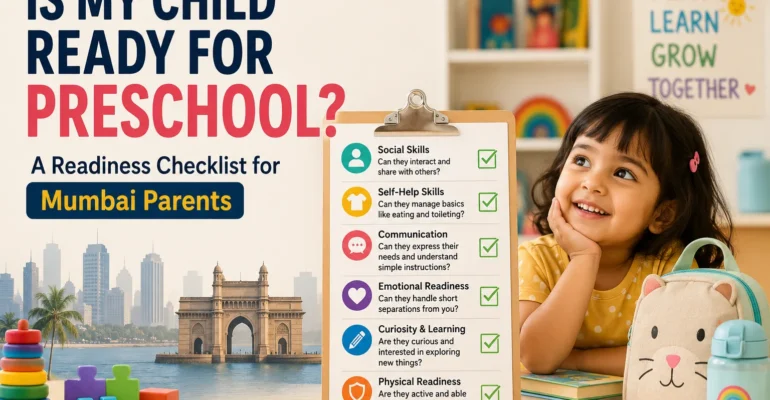
Is My Child Ready for Preschool? A Readiness Checklist for Mumbai Parents
 Admin
Admin Quick Answer
Most children show basic preschool readiness between 2.5 and 3.5 years old — not through academic skills, but through signs like tolerating short separations without prolonged distress, communicating basic needs, and showing interest in other children. Readiness is about emotional and social cues, not whether your child can already recognize letters or numbers.
Long before parents start comparing curricula or touring campuses, most of them ask a much quieter question first: is my child even ready for this yet? It’s one of the most emotionally loaded searches a parent runs — often months before they’ve shortlisted a single school. This checklist walks through the real signs of readiness, what’s normal separation anxiety versus what isn’t, and how to think about timing.
7 Signs Your Child May Be Ready for Preschool
- Tolerates short separations. Your child can be left with a trusted adult (grandparent, relative, caregiver) for an hour or two without prolonged, inconsolable distress.
- Communicates basic needs. Can express hunger, thirst, discomfort, or wanting the toilet — through words, gestures, or simple phrases. Full sentences aren’t required.
- Shows interest in other children. Watches, approaches, or tries to play alongside other kids, even if actual sharing is still a work in progress.
- Manages basic self-care with support. Can attempt eating with some independence, and shows early signs of toilet awareness (not necessarily full toilet training).
- Follows simple two-step instructions. “Pick up the toy and put it in the box” — this signals the attention span needed for a classroom setting.
- Has a predictable routine. Regular nap and meal patterns make the structure of a preschool day much easier to adjust to.
- Curiosity outweighs clinginess most days. Not every day — some clinginess is completely normal — but on balance, your child leans toward exploring rather than staying glued to you.
If your child shows most of these some of the time, that’s a realistic, healthy readiness picture. No child hits all seven consistently — and that’s normal too.
What’s Normal Separation Anxiety vs. What Isn’t
Separation anxiety at this age is developmentally expected, not a sign your child isn’t ready. Here’s how to tell ordinary anxiety apart from a signal to wait a little longer.
| Normal Separation Anxiety | Signals to Wait a Bit Longer |
|---|---|
| Crying at drop-off that settles within 10–20 minutes | Distress that continues for the entire session, day after day |
| Clinginess that eases once a routine is established (1–2 weeks) | No improvement even after several weeks of consistent attendance |
| Reluctance in the morning but calm reports from the teacher later | Regression in eating, sleeping, or toileting that doesn’t stabilize |
| Occasional bad days mixed with good days | Persistent withdrawal or refusal to engage with anyone at school |
A short adjustment period is expected for almost every child. What matters is the trend over two to three weeks, not any single difficult morning.
When Should You Actually Start Preschool in Mumbai?
There’s no single “correct” age — it depends more on your child’s temperament than the calendar. That said, a few practical points are worth knowing:
- Most Mumbai preschools set formal age cut-offs for Playgroup, Nursery, and Jr KG based on the academic year, which can push a “ready” child into waiting a few extra months simply due to the calendar.
- Children who are close to a cut-off but not showing many readiness signs often do better starting the following cycle rather than being pushed in early.
- Readiness is not a race — starting a term or two later rarely puts a child at any real disadvantage, while starting before a child is emotionally ready can make the first few months harder than they need to be.
What to Do If Your Child Isn’t Showing Many Signs Yet
If most of the seven signs above aren’t there yet, that’s useful information, not a red flag:
- Build up separation tolerance gradually — short, planned separations with a trusted caregiver, increasing bit by bit.
- Create simple routines at home (mealtimes, nap times) so the structure of a preschool day feels familiar rather than foreign.
- Encourage low-stakes social contact — a cousin, a neighbour’s child, a playdate — before the higher-stimulation environment of a full classroom.
- Talk to your pediatrician if you’re seeing persistent regression or extreme distress in any separation, however brief — this is worth a conversation regardless of preschool timing.
FAQs
What is the average age children start preschool in Mumbai? Most children begin Playgroup or Nursery between 2 and 3 years old, though exact eligibility depends on each school’s academic-year cut-off date.
Is crying at school drop-off a sign my child isn’t ready? Not necessarily. Some crying that settles within the first 10–20 minutes, and improves over one to two weeks, is a normal adjustment — not a sign of unreadiness.
Does my child need to be toilet trained before starting preschool? Most preschools don’t require full toilet training for Playgroup or Nursery, though early toileting awareness is helpful. Policies vary by school, so it’s worth confirming directly.
Should I delay preschool if my child is anxious in new environments? A generally cautious temperament doesn’t mean you should delay — many children who are slow to warm up still adjust well with a gradual, supported start. Persistent, unrelenting distress over several weeks is the stronger signal to wait.
Can starting preschool too early cause problems? Starting before a child shows basic separation tolerance can make the transition harder, but it isn’t typically harmful long-term. If it’s not going well, most schools and pediatricians recommend a pause and a later restart rather than pushing through.
