


IGCSE vs CBSE in 2026: Which Board Gives Mumbai Students Better University Options?
July 15, 2026 2026-07-15 16:25IGCSE vs CBSE in 2026: Which Board Gives Mumbai Students Better University Options?
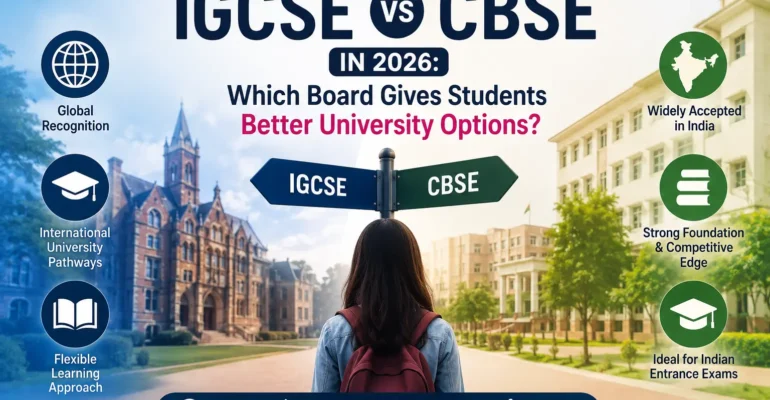
IGCSE vs CBSE in 2026: Which Board Gives Mumbai Students Better University Options?
 Admin
Admin Every year, thousands of Mumbai parents face the same decision at the same moment — usually around the time their child is in Grade 4 or Grade 5 — and it rarely feels straightforward. IGCSE or CBSE? International school or national board? Global curriculum or the path most of their child’s friends are taking?
The honest answer is not the one most school websites give you. It is not “IGCSE is better” or “CBSE is better.” It is: it depends entirely on where your child is going after Grade 12 — and most parents do not think clearly about that until they are already locked into one system.
This guide compares IGCSE and CBSE specifically for Mumbai students in 2026 — not in theory, but in terms of university outcomes, exam eligibility, teaching approach, financial commitment, and what the actual forward pathways look like from each board. By the end, you should be able to make this decision with clarity rather than anxiety.
IGCSE vs CBSE in 2026: What Has Changed and Why It Matters Now
The IGCSE vs CBSE comparison looks different in 2026 than it did five years ago. Three significant shifts have changed the equation for Mumbai parents:
1. NEP 2020 is now being implemented across CBSE schools
The National Education Policy 2020 is actively reshaping how CBSE operates. Rote memorisation is being reduced. Competency-based assessments are increasing. Vocational subjects are being introduced from Grade 6. The revised CBSE curriculum is moving — slowly but measurably — toward a more skills-based approach. This narrows some of the philosophical gap between CBSE and Cambridge, but the structural differences in assessment, subject flexibility, and global recognition remain significant.
2. CUET has standardised Indian university admissions
Since 2022, the Common University Entrance Test (CUET) has become the primary gateway for undergraduate admissions at central universities across India — including Delhi University, JNU, Banaras Hindu University, and over 200 others. CUET is board-agnostic: it tests content knowledge directly, and students from any board — CBSE, ICSE, or Cambridge IGCSE — are equally eligible to appear. This has meaningfully levelled the playing field for IGCSE students targeting Indian universities.
3. International university acceptance of Indian students has grown sharply
Applications from Indian students to UK, US, Canadian, and Australian universities have reached record highs. According to the UK’s UCAS data, Indian student applications to UK universities grew significantly through 2023-25. Cambridge A Level holders from India — including Mumbai — are among the most consistently well-represented applicants at mid-tier and target UK universities, precisely because the A Level is the UK’s domestic university entrance qualification. This changes the value calculation of the IGCSE pathway considerably for families with any possibility of overseas study.
Understanding the Two Boards: The Core Difference
Before comparing university outcomes, it helps to be clear about what each board actually is — because the most common confusion among Mumbai parents is treating CBSE and IGCSE as interchangeable alternatives when they are philosophically quite different systems.
What CBSE Actually Is
CBSE (Central Board of Secondary Education) is India’s national board, governed by the Union Government of India and following the NCERT curriculum. It is structured, syllabus-driven, and assessment-heavy. The primary goal of the CBSE curriculum is to build strong content knowledge across a defined set of subjects, with clear preparation for India’s national competitive examinations — particularly JEE and NEET.
CBSE is followed by over 27,000 schools across India. It is the default choice for families who move between cities frequently, because a CBSE school in Mumbai follows the same syllabus as one in Delhi, Bangalore, or Chennai. It is also significantly more affordable than an international curriculum school.
What IGCSE Actually Is
Cambridge IGCSE (International General Certificate of Secondary Education) is a globally recognised secondary school qualification administered by Cambridge Assessment International Education (CAIE). Unlike CBSE, which covers Grades 1 through 12 within one framework, IGCSE specifically covers Grades 9 and 10 — the secondary years. It is preceded by Cambridge Primary and Lower Secondary, and followed by Cambridge A Levels.
IGCSE offers over 70 subjects with no fixed stream restrictions. Students build their own subject combination across five curriculum groups, assessed through a mix of examinations, coursework, and practical components. The emphasis is on inquiry-based learning, analytical thinking, and independent reasoning rather than content recall.
The critical point most parents miss: IGCSE is a Grade 10 qualification. For university admission in India or abroad, students still need a Grade 12 equivalent — either Cambridge A Levels, IB Diploma, or another accepted senior secondary qualification. Comparing “IGCSE vs CBSE” is really a comparison of two different educational philosophies across the school years, not just two exam certificates.
IGCSE vs CBSE: A Direct Comparison Across What Matters Most
Teaching Approach and How Your Child Actually Learns
| Factor | CBSE | Cambridge IGCSE |
|---|---|---|
| Learning philosophy | Syllabus-based, content mastery | Inquiry-based, skills-focused |
| Assessment style | Primarily year-end board exams | Mix of exams, coursework, and practicals |
| Subject flexibility | Fixed streams (Science, Commerce, Arts) | 70+ subjects, cross-stream combinations |
| Classroom approach | Teacher-led, structured | Student-led enquiry, discussion, project work |
| Focus | Depth in defined subjects, exam readiness | Analytical thinking, global perspectives |
| Language medium | English and other language mediums available | Primarily English medium |
In a CBSE classroom, the question is typically: what happened? Students learn content, understand it, and reproduce it in a structured exam format. In a Cambridge IGCSE classroom, the question is: why did this happen, and what does it mean? Students are expected to investigate, evaluate sources, construct arguments, and demonstrate understanding through multiple formats.
Neither approach is superior in the abstract. What matters is which approach your child responds to better — and where they are going after Grade 12.
University Options: Indian Universities
This is the most critical section for most Mumbai parents, and the one most school blogs handle vaguely.
For CBSE students:
CBSE is directly aligned with India’s undergraduate admission ecosystem. Board marks are accepted by Mumbai University and affiliated colleges, Delhi University (via CUET), NMIMS, Symbiosis, Pune University, and virtually every Indian university without any additional documentation. For JEE and NEET, CBSE is the default preparation framework — coaching institutes, study materials, and exam patterns are all built around the NCERT syllabus that CBSE follows.
For Cambridge IGCSE + A Level students:
IGCSE is recognised as equivalent to Class 10, and Cambridge A Levels are recognised as equivalent to Class 12 through the Association of Indian Universities (AIU) equivalence framework. Students need to apply for an AIU Equivalence Certificate after A Level results — a process that takes 4 to 8 weeks and should be initiated immediately after results are released. Once the certificate is obtained, Cambridge A Level students are eligible for:
- Mumbai University affiliated colleges — NMIMS, K. J. Somaiya, Narsee Monjee, and hundreds of affiliated colleges across the city
- Delhi University (via CUET) — A Level students are eligible to appear for CUET; the test is board-agnostic
- Christ University, Bangalore — explicitly welcomes Cambridge A Level students
- Ashoka University, OP Jindal, FLAME — actively recruit Cambridge students, often preferring the analytical and writing skills the curriculum develops
- IITs (via JEE) — technically eligible, but requires substantial additional NCERT-based preparation
- Medical colleges (via NEET) — technically eligible with Physics, Chemistry, and Biology at A Level, with the same caveat about NCERT preparation
The honest summary on Indian universities: For general undergraduate programmes in business, economics, law, arts, commerce, and science — the Cambridge pathway provides equivalent access to Indian universities as CBSE. For JEE and NEET specifically, CBSE’s alignment with the exam syllabus is a genuine structural advantage that requires deliberate supplementary work to overcome from the Cambridge side. You can read a detailed breakdown of this in our guide on whether IGCSE is recognised by Indian universities.
University Options: International Universities
This is where the two boards diverge most significantly.
Cambridge IGCSE and A Levels are recognised by over 2,000 universities across 160 countries. In the UK specifically, A Levels are the domestic university entrance qualification — Cambridge students from Mumbai apply to UK universities on exactly the same footing as UK school leavers. No additional bridge programmes, no foundation years, no conversion qualifications required.
For US universities, Cambridge A Level students typically apply with A Level predicted grades alongside SAT or ACT scores, and their applications are reviewed on par with AP or IB students. Many US admissions officers actively value A Level students for the depth of subject study (typically 3-4 subjects studied in genuine depth over two years).
For Australian and Canadian universities, Cambridge A Levels are directly mapped to entry requirements without additional conversion steps.
For CBSE students applying internationally: CBSE is accepted by most international universities, but the pathway is rarely as direct. UK universities typically require CBSE students to demonstrate English proficiency separately and may require SAT or foundation programme completion depending on the institution. This is changing as Indian student volumes increase, but the structural advantage of the Cambridge route for international applications remains meaningful in 2026.
The JEE and NEET Question: The Honest Answer
This is where most comparison articles either oversimplify or mislead. Here is what is actually true in 2026:
JEE and NEET eligibility: Both JEE Main and NEET require candidates to have passed Class 12 (or equivalent) with Physics, Chemistry, and Mathematics (for JEE) or Biology (for NEET). Cambridge A Level students who have taken the relevant science subjects are technically eligible for both examinations.
The practical reality: JEE Main, JEE Advanced, and NEET are built entirely around the NCERT syllabus. The question patterns, the topic sequencing, and the speed requirements of these exams are all calibrated to CBSE Class 11 and 12 content. A Cambridge A Level student studying Physics, Chemistry, and Mathematics has covered equivalent — often deeper — content, but not in the NCERT framework. The gap is not knowledge; it is pattern familiarity and exam technique specific to Indian competitive exams.
The result: an A Level student targeting JEE or NEET needs dedicated NCERT-based coaching running alongside their A Level programme — typically from Grade 10 onwards. This is an additional commitment in time, money, and mental bandwidth that a CBSE student does not face. It is achievable, but it requires early planning and a school with strong career counselling. At top IGCSE schools in Mumbai like Panbai International School, career counselling from Grade 7 ensures students with medical or engineering ambitions identify this early enough to plan accordingly.
The bottom line: If JEE or NEET is your child’s specific, committed goal, CBSE is the structurally simpler choice. If international universities or general Indian undergraduate programmes are the destination, IGCSE + A Levels is the stronger platform.
Fees: What the Cost Difference Actually Looks Like
This is a real differentiator and worth addressing directly.
| Level | CBSE School (annual fees, Mumbai) | Cambridge IGCSE School (annual fees, Mumbai) |
|---|---|---|
| Primary (Grade 1-5) | ₹40,000 – ₹1,50,000 | ₹2,50,000 – ₹6,00,000 |
| Secondary (Grade 6-10) | ₹60,000 – ₹2,00,000 | ₹3,50,000 – ₹7,00,000 |
| Senior Secondary (Grade 11-12) | ₹70,000 – ₹2,50,000 | ₹4,00,000 – ₹8,00,000 (A Levels) |
Cambridge schools also add Cambridge board examination fees (₹80,000 to ₹1,20,000 per exam session at IGCSE and A Levels), which are charged separately and are not included in the tuition figure.
The fee gap is real and substantial. Over a 13-year school journey, the difference between a mid-range CBSE school and a mid-range Cambridge school in Mumbai can be ₹40 to ₹60 lakh cumulatively. That is a financial decision that deserves as much weight as the academic one.
The question worth asking: does the Cambridge pathway offer enough differentiated value — in learning approach, university options, and outcomes — to justify that cost difference for your specific family? For families where international university study is a genuine goal, the answer is often yes. For families where India is the clear destination, the calculus is less straightforward.
Which Child Thrives in Which System?
This is the question most parents ask last but should ask first.
A child who thrives in CBSE typically:
- Is disciplined, structured, and comfortable with exam-oriented learning
- Has a specific target — particularly engineering or medicine — that requires JEE or NEET preparation
- May need to move between cities due to family circumstances
- Learns well in a larger classroom with a defined syllabus and clear milestones
A child who thrives in Cambridge IGCSE typically:
- Is curious, questioning, and enjoys exploring topics rather than memorising them
- Has multiple interests that span subjects across traditional streams
- May be considering international universities alongside Indian options
- Responds better to a mix of assessment formats — discussions, presentations, coursework — rather than a single annual exam
Neither profile is more “intelligent” or “capable.” They are simply different learning orientations. The most honest advice: if you are genuinely unsure, speak to a teacher who knows your child well. Their assessment of how your child learns is more valuable than any comparison article — including this one.
What Mumbai Parents Specifically Should Consider in 2026
Mumbai’s educational landscape has a few factors that make the IGCSE vs CBSE decision slightly different here than in other Indian cities.
CUET has equalised Indian university access for IGCSE students
Since the introduction of CUET, IGCSE students in Mumbai no longer face the disadvantage of board-specific marks being used for university admission at central universities. The test is the same for everyone. This has meaningfully reduced one of the traditional arguments for CBSE among parents who wanted both India and international options left open.
Mumbai’s western suburbs has a strong Cambridge school cluster
The concentration of CAIE-affiliated schools in Santacruz, Bandra, Juhu, and Andheri — including Panbai International School — means that Cambridge schooling in Mumbai is no longer a premium-only option. Mid-range Cambridge schools are accessible to a broader set of families than was the case even five years ago, reducing the fee premium compared to other metros.
Career counselling quality matters more than board choice
The Mumbai parents who consistently report the best outcomes — regardless of board — are those whose children were in schools with structured, multi-year career counselling. Knowing by Grade 8 whether your child is heading toward UK universities, Indian management programmes, or a science stream changes every subsequent decision: subject choice at IGCSE, A Level combinations, entrance exam preparation timelines. Schools that begin this process early give families time to plan, not just react. Explore how the benefits of an international school education compound over time when the curriculum and the counselling are aligned.
IGCSE vs CBSE: Which Board Should You Choose?
Rather than a single answer, here is a decision framework based on your family’s actual situation:
Choose Cambridge IGCSE if:
- International universities are a genuine possibility for your child
- Your child may relocate globally — the Cambridge curriculum is the same in Singapore, Dubai, UK, or Mumbai
- Your child’s interests span multiple subjects across traditional streams
- You value inquiry-based learning and assessment diversity over exam-only evaluation
- Your child is likely to continue through A Levels at the same school (curriculum continuity matters enormously)
Choose CBSE if:
- JEE or NEET is a committed, specific goal — not a vague possibility
- Your family moves between Indian cities, and curriculum continuity across locations matters
- You want to keep costs meaningfully lower while maintaining a strong academic foundation
- Your child learns well in a structured, syllabus-defined environment with clear milestones
Consider both seriously if:
- You are genuinely unsure about where your child will study after Grade 12 — in which case, look for schools with strong career counselling that helps you answer this question well before Grade 9, not after
For Mumbai parents who have decided that the Cambridge pathway is the right fit and are now evaluating specific schools, understanding what makes an international school genuinely different in practice — beyond the curriculum brochure — is the next useful step.
How Panbai International School Approaches This Decision
At Panbai International School in Santacruz East, career counselling begins formally from Grade 7 — not as a Grade 10 panic exercise, but as a structured, ongoing conversation that helps students and families make the IGCSE vs CBSE decision (and every subsequent subject choice) with clarity about the destination.
For families who choose the Cambridge route, Panbai offers the complete pathway: Cambridge Early Years through Primary, Lower Secondary, IGCSE, and A Levels — all under one roof. Students do not need to change schools between Grade 10 and Grade 11, which removes one of the most disruptive transitions in a teenager’s academic journey. The school has a 15:1 student-to-teacher ratio, 92% of faculty with advanced degrees, and a verified track record of university placements across the UK, US, Canada, and India — including IIT Dharwad, NMIMS Mumbai, Boston University, Nottingham Trent University, and California State University.
For parents currently evaluating this decision, the admissions team at Panbai is available to walk through the options in the context of your child’s specific profile — not as a sales exercise, but as the kind of structured counselling conversation that makes the IGCSE vs CBSE choice much clearer in practice.
Frequently Asked Questions
Is IGCSE better than CBSE in 2026?
Neither board is universally better. IGCSE + A Levels is the stronger platform for international university admission and for students who benefit from inquiry-based, flexible subject learning. CBSE is the stronger choice for students specifically targeting JEE or NEET, or for families where India is the clear long-term destination and cost is a significant factor. The right answer depends entirely on your child’s learning style and your family’s forward plans — not on a general ranking of boards.
Does IGCSE give better university options than CBSE?
For international universities — UK, US, Canada, Australia — yes, Cambridge IGCSE and A Levels provide a more direct, structurally simpler pathway to admissions. For Indian universities and general undergraduate programmes, both boards provide equivalent access, particularly since the introduction of CUET equalised central university admissions. For JEE and NEET specifically, CBSE’s alignment with the NCERT exam syllabus is a genuine advantage.
Can a CBSE student get into international universities?
Yes. CBSE students do get into UK, US, and other international universities, but the pathway typically requires additional steps — English proficiency tests, SAT or ACT scores, and sometimes foundation programmes depending on the destination and institution. Cambridge A Level students apply to these same universities on a more direct footing, particularly in the UK where A Levels are the domestic entrance qualification.
Is IGCSE harder than CBSE?
The difficulty comparison depends on the child. CBSE has a denser, more syllabus-heavy content load in subjects like Physics, Chemistry, and Mathematics — which is why it aligns so well with JEE and NEET preparation. IGCSE is arguably more demanding in terms of analytical writing, independent research, and multi-format assessment, but less dense in factual content recall. Students who are strong memorisers often find CBSE’s format more manageable. Students who are strong analytical thinkers often find Cambridge more rewarding.
What happens after IGCSE in Mumbai — what are the options?
After completing IGCSE, a Mumbai student has three main paths: continue to Cambridge A Levels at the same school (the most seamless route, which opens the widest range of university options globally and in India); transfer to CBSE or Maharashtra State Board for Grade 11-12 (chosen by some students specifically targeting JEE or NEET); or pursue international foundation programmes at certain universities. Staying in the Cambridge system through A Levels is almost always the recommended route for families who chose IGCSE deliberately.
Is CUET available for IGCSE students?
Yes. CUET (Common University Entrance Test) is fully open to Cambridge A Level students. The test is board-agnostic — it tests subject knowledge directly and does not favour any particular board’s syllabus. This means IGCSE students now have the same access to CUET-based admissions at Delhi University, JNU, and 200+ other central universities as CBSE students do.
Which board is better for a child who might study in India or abroad — keeping options open?
Cambridge IGCSE + A Levels is the better choice for keeping both options open. It provides direct access to international universities and equivalent access to Indian universities via AIU recognition and CUET eligibility. The only scenario where this answer changes is if JEE or NEET is a committed goal — in which case, the CBSE alignment with those specific exams is too significant to ignore without a clear supplementary preparation plan.
At what point is it too late to switch from CBSE to IGCSE?
The earlier the switch, the smoother the transition. Switching at the primary level (Grade 1-5) involves virtually no disruption — the child grows into the Cambridge approach naturally. Switching in Grade 6 or 7 involves some adjustment to a more inquiry-based learning style but is entirely manageable. Switching in Grade 9 — at the start of IGCSE — under the pressure of board exams is the most difficult transition and should only be considered with strong school support and a clear rationale. Switching after Grade 10 is rarely sensible.
