

Is IGCSE Better Than CBSE? An Honest Comparison for Parents
June 17, 2026 2026-06-15 13:22Is IGCSE Better Than CBSE? An Honest Comparison for Parents
Is IGCSE Better Than CBSE? An Honest Comparison for Parents
 Admin
Admin “Is IGCSE better than CBSE?” is one of the most searched questions among parents in Mumbai — and honestly, it’s also one of the most debated. Spend ten minutes on parenting forums or Reddit threads and you’ll find passionate opinions on both sides, often based on one family’s personal experience rather than a complete picture.
So let’s try to do something different here. Instead of declaring a winner, we’ll walk through what each board actually does differently, who tends to benefit from which approach, and where the real trade-offs are. By the end, you should be able to answer this question for your child — which is really the only version of the question that matters.
The Short Answer
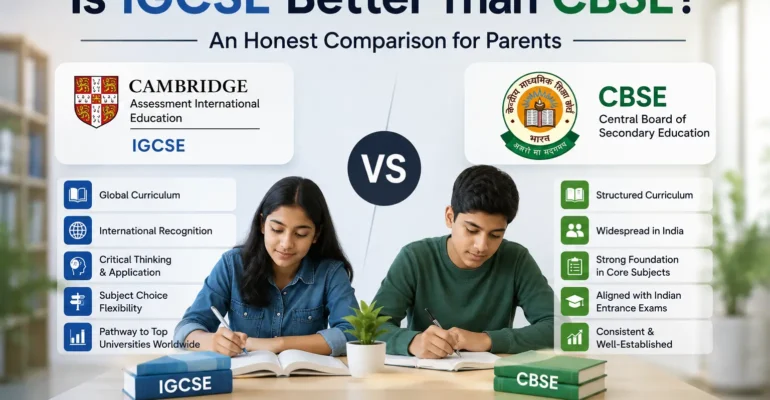
Neither board is universally “better” — they’re built around different philosophies of learning. CBSE is structured, exam-focused, and tightly aligned with India’s national entrance tests like JEE and NEET. IGCSE (the Cambridge International curriculum) is built around conceptual understanding, application, and flexibility, and is recognised globally.
If your child thrives with clear structure and you know they’re aiming for JEE or NEET from early on, CBSE has real advantages. If your child is curious, does well with open-ended problems, and you want to keep both Indian and international university options open, IGCSE tends to be the stronger fit.
That’s the honest answer. Now let’s get into why.
How the Two Curricula Actually Differ
Teaching Philosophy
CBSE textbooks (typically NCERT) are designed around a defined syllabus that students work through systematically, with a strong emphasis on covering content thoroughly — which pairs well with India’s competitive exam culture.
Cambridge IGCSE, by contrast, is built to test how students think, not just what they remember. Assessment includes written, oral, coursework, and practical components, and many subjects let students choose between core and extended levels depending on their strengths. Grades are benchmarked using the internationally recognised A* to G scale.You can explore the complete subject list and assessment structure on Cambridge International’s official curriculum overview.
Assessment Style
This is where the “harder vs easier” debate usually comes from — and honestly, it’s the wrong framing. CBSE exams reward thorough preparation and recall of a defined syllabus. IGCSE exams reward applying knowledge to new situations — which can feel harder to “prepare” for in the traditional sense, because you can’t simply memorise your way through it.
Neither is objectively harder. They’re testing different skills.
Subject Flexibility
CBSE follows a fairly fixed subject structure. IGCSE offers significantly more choice — students pick from a wide range of core and elective subjects, which means two students at the same school can end up with quite different subject combinations based on their interests.
Where CBSE Has Real Advantages
We’re not going to pretend CBSE doesn’t have strengths, because it does:
- Direct alignment with JEE, NEET, and other Indian entrance exams — if your child’s goal is engineering or medicine in India, CBSE’s syllabus maps closely onto these exams.
- Widespread familiarity — CBSE is the most common board in India, so transferring schools (if your family relocates) is usually simpler.
- Lower cost in many cases — CBSE schools are often (though not always) more affordable than international curriculum schools.
If these factors are your family’s top priorities, CBSE is a perfectly reasonable — even excellent — choice.
Where IGCSE Has Real Advantages
Equally, here’s where IGCSE tends to pull ahead:
- Global recognition — GCSE and Cambridge A Levels are accepted by universities in 160+ countries, and importantly, also recognised in India by the Association of Indian Universities (AIU) — so it’s not an either/or choice between India and abroad.
- Skill development beyond exams — the emphasis on application, analysis, and independent thinking tends to translate well into how universities (Indian and international) expect students to work.
- Subject flexibility — students can tailor their learning toward strengths and interests rather than following one fixed path.
- Smoother transition to A Levels — for families considering Cambridge A Levels after Grade 10, IGCSE is the natural and intended precursor.
What This Looks Like in Practice — Panbai’s Experience
We can speak to this from direct experience. At Panbai International School in Santacruz East, students follow the Cambridge Pathway from Cambridge Primary (Grades 1–5) through Cambridge Lower Secondary (Grades 6–8) and into Cambridge IGCSE (Grades 9–10) — so by the time IGCSE arrives, the assessment style isn’t new or sudden. It’s a continuation of how students have been learning all along.
This matters for the “is IGCSE better than CBSE” question specifically, because a lot of the difficulty people associate with IGCSE actually comes from switching boards mid-way — arriving at IGCSE in Grade 9 from a completely different system. When the foundation is built early, that friction largely disappears.
The results back this up. Cambridge IGCSE graduates from Panbai have gone on to institutions including IIT Dharwad (Mechanical Engineering) and NMIMS Mumbai, while Cambridge A-Level graduates have secured admissions at Boston University, Nottingham Trent University (UK), California State University (USA), K. J. Somaiya, Vellore Institute of Technology, and the International Medical University, Malaysia. That spread — strong Indian institutions and international universities — is precisely the flexibility IGCSE is designed to offer.
Faculty matter here too. At Panbai, 92% of educators hold advanced degrees and are specifically trained in Cambridge pedagogy, which is genuinely different from teaching CBSE — a teacher needs to understand how to develop the analytical and application-based skills Cambridge assessments require, not just deliver content.
So — Is IGCSE Better Than CBSE for Your Child?
Here’s a simple way to think about it:
IGCSE may be the better fit if:
- Your child enjoys open-ended problems and applying concepts in new ways
- You want to keep both Indian and international university options genuinely open
- You’re considering Cambridge A Levels after Grade 10
- You can enrol early enough (ideally before Grade 9) for the transition to be gradual
CBSE may be the better fit if:
- Your child’s goals are clearly focused on JEE, NEET, or similar Indian entrance exams
- You value the widespread familiarity and portability of CBSE within India
- Budget considerations favour CBSE schools in your area
If, after reading this, IGCSE feels like the right direction for your family, it’s worth looking closely at how a school delivers the curriculum — not just whether it offers it. Curriculum continuity, faculty training, and where alumni actually end up are the factors that separate a strong IGCSE programme from a weak one. We’ve written more about what to look for in our guide to the best IGCSE schools in Mumbai.
Frequently Asked Questions
Is it difficult to switch from CBSE to IGCSE midway through school?
It’s possible, but it gets harder the later the switch happens. Switching during primary years is relatively smooth; switching right before IGCSE (Grade 9) is the most challenging transition, since the assessment style is quite different. Schools that offer the full Cambridge Pathway from Grade 1 avoid this issue entirely.
Does IGCSE prepare students for JEE and NEET?
Not directly — IGCSE doesn’t follow the same syllabus structure as CBSE, which is closely mapped to these exams. Students aiming for JEE or NEET from an IGCSE background typically need supplementary, exam-specific coaching. However, IGCSE’s emphasis on conceptual understanding does provide a strong foundation for this additional preparation.
Is IGCSE recognised by Indian universities?
Yes. Cambridge IGCSE and A Level qualifications are recognised by the Association of Indian Universities (AIU), meaning students can apply to Indian colleges and universities with their Cambridge results, in addition to international options.
If, after reading this, IGCSE feels like the right direction for your family, it’s worth looking closely at how a school delivers the curriculum — not just whether it offers it. Curriculum continuity, faculty training, and where alumni actually end up are the factors that separate a strong IGCSE programme from a weak one. We’ve written more about what to look for in our guide to the best IGCSE schools in Mumbai.
Still Deciding? Come Talk to Us
Choosing between boards is a genuinely personal decision, and we’d rather help you think it through than push you toward one answer. If you’d like to discuss your child’s specific situation — or see how the Cambridge Pathway works in practice — we’re happy to talk.
Panbai International School Guru Narayan Road, Near BMC Office, Sen Nagar, Santacruz East, Mumbai – 400055 📞 +91 7700096669 | +91 7400011774 ✉ admin@panbaiinternationalschool.com
